0b5b384651
- Introduce new API to mark an app that it can't be disabled.

- Mark jsxc, storage, config, upgrade and firewall apps as can't be disabled.

- Fixed functional tests

- Replaced AppForm with forms.Form in all modules' forms.py.

- Remove app.template.js.

- Remove unused styles.

- Remove app status checks in form_valid of Deluge, Diaspora, Matrix, Ejabberd,
MediaWiki, Storage, Transmission, Quassel

- Purge unused is_enabled context variables (Ikiwiki)

- ejabberd: Minor cleanup in template

- jsxc: Cleanup unneeded overrides

- tahoe: Cleanup unnecessary overrides

Tests performed:

- For all apps affected, test enable/disable button works and submitting
configuration form works: with changes updates message and without changes
'settings unchanged' message.
  - avahi
  - bind
  - cockpit
  - SKIP: coquelicot
  - datetime
  - deluge
  - SKIP: diaspora
  - ejabberd
  - gitweb
  - i2p
  - infinoted
  - ikiwiki
  - matrixsynapse
  - mediawiki
  - minetest
  - minidlna
  - mldonkey
  - mumble
  - pagekite
  - privoxy
  - quassel
  - radicale
  - roundcube
  - SKIP: samba
  - searx
  - SKIP: shaarli
  - shadowsocks
  - ssh
  - tahoe
  - transmission
  - FAIL: tt-rss (not installable)
  - wireguard
- Deluge test that configuration changes when app is disabled work
- Quassel test that setting the domain works when app is diabled
- Transmission test that setting the domain works when app is diabled
- Ikiwiki create form works properly
- Enable/disable button appears as expected when enabled and when disabled
- Enable/disable button works without Javascript
- Functional tests work for affected apps, Tor and OpenVPN
- AppForm is removed from developer documentation
  - Forms reference
  - Customizing tutorial
- Test all apps using directory select form
  - Transmission
  - Deluge
- Visit each template that overrides block configuration and ensure that it is
loaded properly and the display is as expected.
- All apps that use AppView that are not tested above should not have an
enable/disable button. That is JSXC, update, config, firewall, storage, users.

Signed-off-by: Alice Kile <buoyantair@protonmail.com>
Signed-off-by: Sunil Mohan Adapa <sunil@medhas.org>
Reviewed-by: Veiko Aasa <veiko17@disroot.org>





FreedomBox Service (Plinth)
The core functionality and web front-end of FreedomBox.
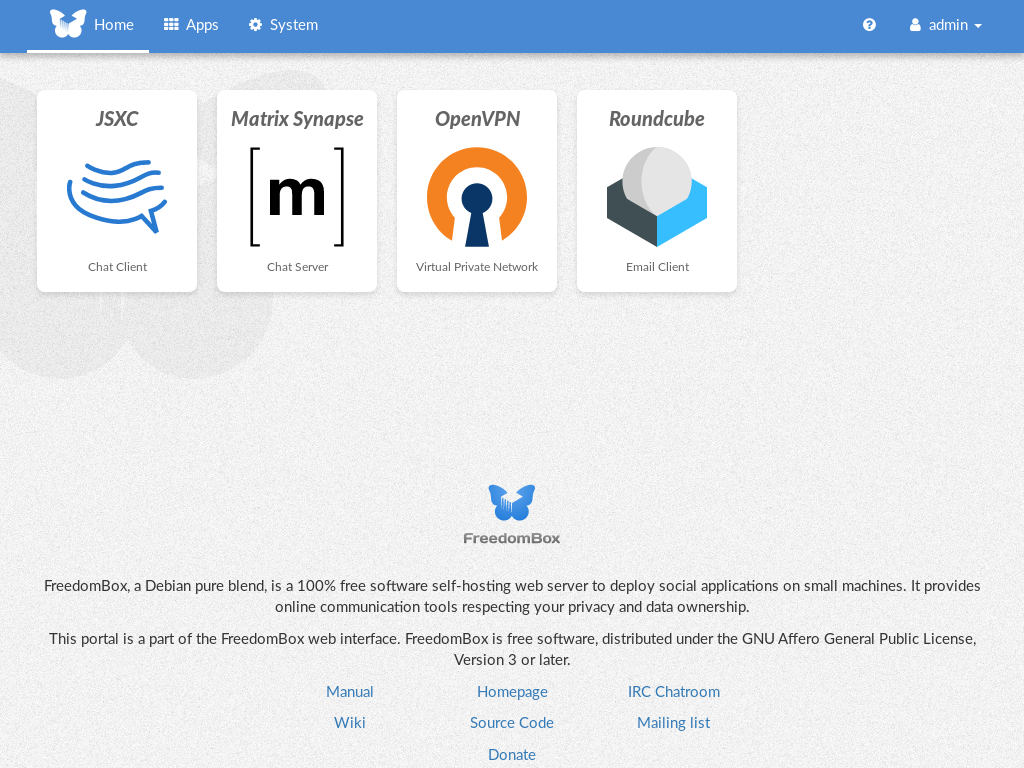


Description
FreedomBox is a community project to develop, design and promote personal servers running free software for private, personal communications. It is a networking appliance designed to allow interfacing with the rest of the Internet under conditions of protected privacy and data security. It hosts applications such as blog, wiki, website, social network, email, web proxy and a Tor relay, on a device that can replace your Wi-Fi router, so that your data stays with you.
This module, called FreedomBox Service and also know as Plinth, is the core functionality and web interface to the functions of the FreedomBox. It is extensible and provides various applications of FreedomBox as modules. Each module or application provides simplified user interface to control the underlying functionality. As FreedomBox can act as a wireless router, it is possible to configure networking. It also allows configuration of basic system parameters such as time zone, hostname and automatic upgrades.
You can find more information about FreedomBox Service (Plinth) on the Plinth Wiki page, the FreedomBox Wiki and the FreedomBox Manual.
Getting Started
To have a running FreedomBox, first install Debian (Buster or higher) on a clean machine. Then run:
$ sudo apt install freedombox
Full instructions are available on FreedomBox Manual's QuickStart page.
For instructions on running the service on a local machine from source code, see INSTALL.md. For instructions on setting up for development purposes, see HACKING.md.
Contributing
See the HACKING.md file for contributing to FreedomBox Service (Plinth).
Localization