2ffde1b646
- Matrix Synapse will automatically pick up the locally installed coturn server
during its installation. This handles only the case where coturn is installed
and configured with a valid TLS domain name before matrix-synapse is installed.

- Allow overriding STUN/TURN config. Matrix Synapse uses the local coturn
server's configuration by default. However, an administrator can override the
STUN/TURN configuration from FreedomBox web interface. Allow administrator's
overrides to co-exist with FreedomBox's managed STUN/TURN configuration.
Administrator's configuration, if it exists, always overrides FreedomBox's
managed configuration. Any updates to FreedomBox's managed configuration will
have no impact on the administrator's configuration since the latter takes
precedence.

Sunil:

- Collapse multiple turn actions into a single one for simplicity. Sending empty
configuration means removal of the configuration.

- Ensure that when removing configuration file is idempotent.

- Manage TURN configuration even when app setup is not yet completed. This fixes
issue with TURN configuration not getting setup on app installation and setup.

- Fix issue with TURN configuration getting updated on form submission even when
the field is not changed. This is due to mismatch between the browser submitted
\r\n with the internal \n.

- Simplify JavaScript for the form and attach handlers only after DOM is ready.

- Drop the no-JS message since the loss of functionality is trivial and to
reduce translation burden.

- Fix issue with URIs and secret parameters not getting updated unless the
managed checkbox changes.

- Drop specialized success messages for TURN configuration update to reduce
translation burden.

Signed-off-by: Joseph Nuthalapati <njoseph@riseup.net>
Signed-off-by: Sunil Mohan Adapa <sunil@medhas.org>
Reviewed-by: Sunil Mohan Adapa <sunil@medhas.org>





FreedomBox Service (Plinth)
The core functionality and web front-end of FreedomBox.
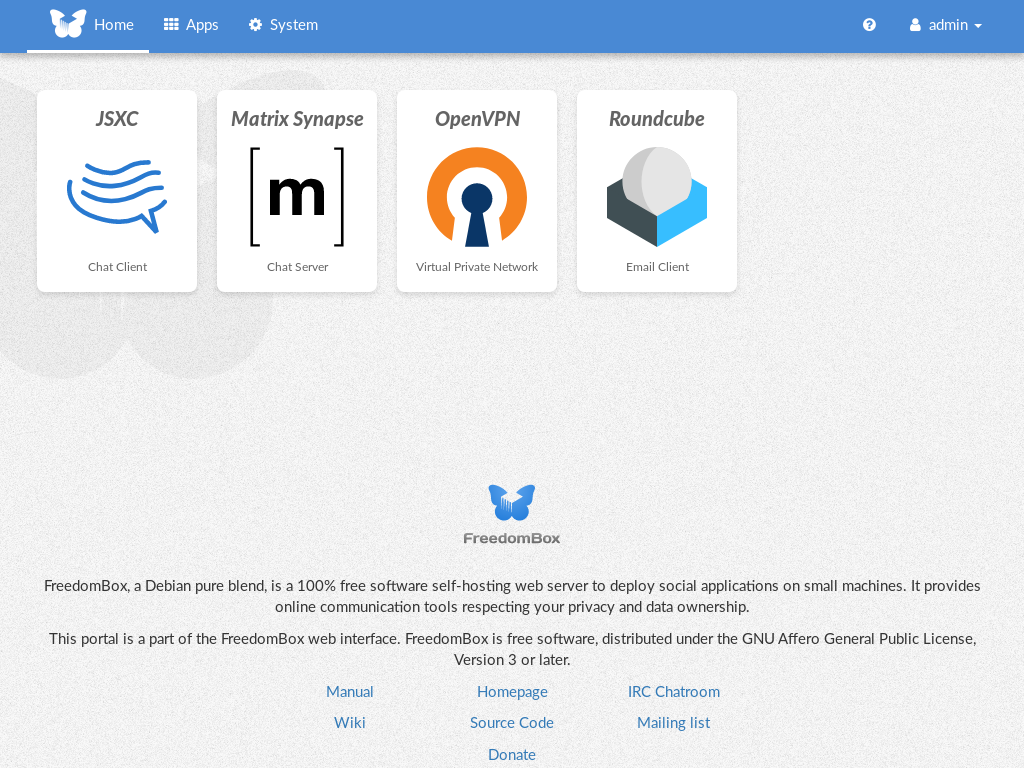
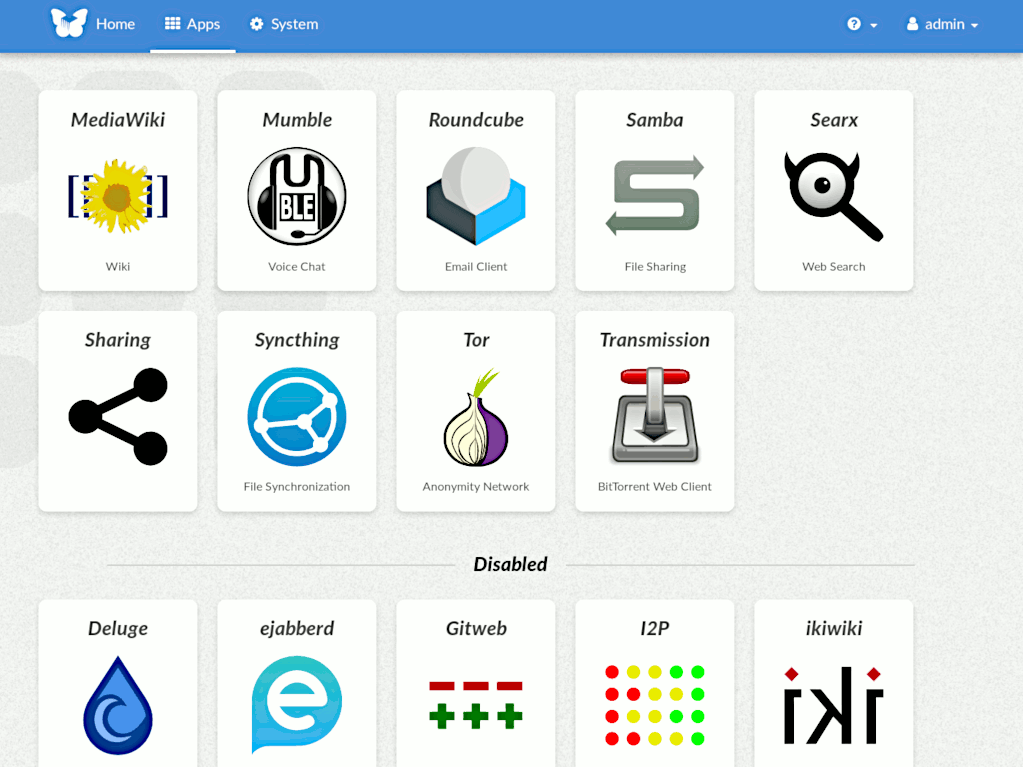


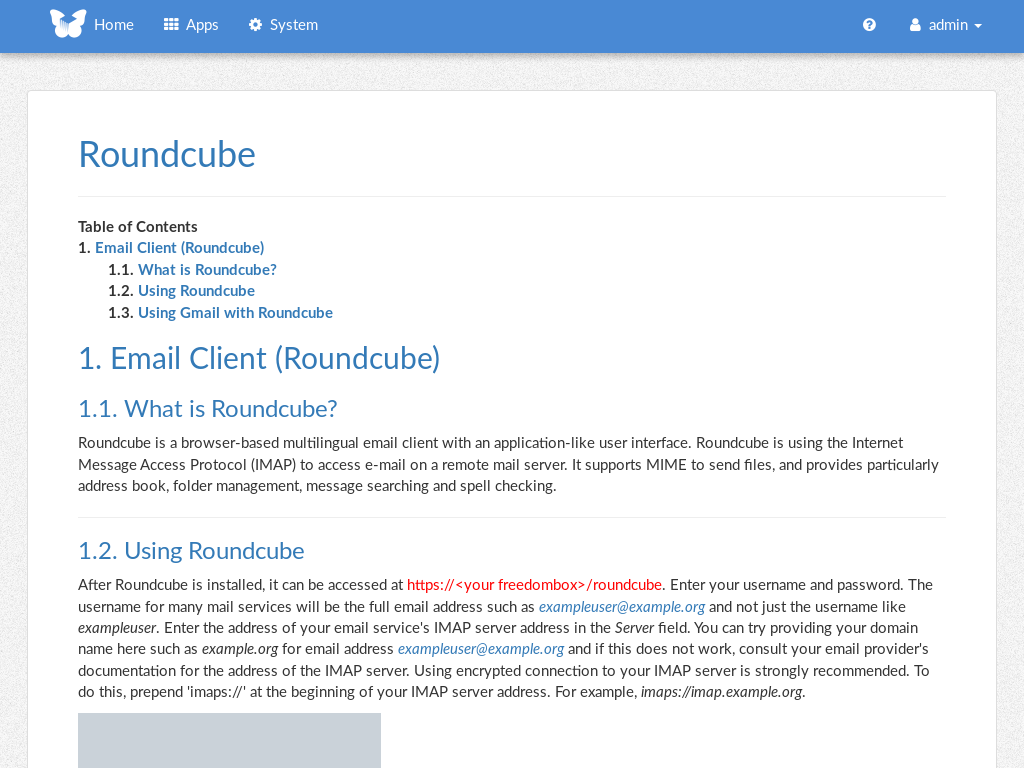

Description
FreedomBox is a community project to develop, design and promote personal servers running free software for private, personal communications. It is a networking appliance designed to allow interfacing with the rest of the Internet under conditions of protected privacy and data security. It hosts applications such as blog, wiki, website, social network, email, web proxy and a Tor relay, on a device that can replace your Wi-Fi router, so that your data stays with you.
This module, called FreedomBox Service and also know as Plinth, is the core functionality and web interface to the functions of the FreedomBox. It is extensible and provides various applications of FreedomBox as modules. Each module or application provides simplified user interface to control the underlying functionality. As FreedomBox can act as a wireless router, it is possible to configure networking. It also allows configuration of basic system parameters such as time zone, hostname and automatic upgrades.
You can find more information about FreedomBox Service (Plinth) on the Plinth Wiki page, the FreedomBox Wiki and the FreedomBox Manual.
Getting Started
To have a running FreedomBox, first install Debian (Buster or higher) on a clean machine. Then run:
$ sudo apt install freedombox
Full instructions are available on FreedomBox Manual's QuickStart page.
For instructions on running the service on a local machine from source code, see INSTALL.md. For instructions on setting up for development purposes, see HACKING.md.
Contributing
See the HACKING.md file for contributing to FreedomBox Service (Plinth).
Localization