40eecb6446
- This will leave /etc/{plinth,freedombox} empty by default making service more
robust to run across various environments and situations. See systemd's
explanation for more details.

- Use Debian maintainer scripts remove all the existing files in
/etc/plinth/modules-enabled.

- Read from /usr/share/freedombox/modules-enabled then from
/etc/plinth/modules-enabled and finally from /etc/freedombox/modules-enabled.
Later read ones override previously read files. Any file pointing to /dev/null
will mean the module must be ignored.

Tests:

- Clean up /etc/plinth, /etc/freedombox and
/usr/share/freedombox/modules-enabled. Run service and notice that files are
getting loaded from development folder using a debug message.

- Run setup.py and notice that files get installed in
/usr/share/freedombox/modules-enabled/ and in the next run they get loaded from
there.

- Create a override file in /etc/plinth/modules-enabled/transmission and notice
that overriden file gets priority over the one in
/usr/share/freedombox/modules-enabled.

- Link the file /etc/plinth/modules-enabled/transmission to /dev/null and notice
that is not loaded.

- Create another file in /etc/freedombox/modules-enabled/transmission and notice
that it overrides the previous two files.

- All affected modules are loaded.

- Build a new Debian package and ensure that upgrading 23.8 to new version
removes are all configuration files.

- Build developer documentation and test that Tutorial -> Full Code and Tutorial
-> Skeleton sections have been updated with references to
-.../modules-enabled/... paths.

- Install quassel and notice that certificates were copied to /var/lib/quassel
directory. Change domain to another domain and notice that certificates were
copied again to that directory.

Reviewed-by: James Valleroy <jvalleroy@mailbox.org>





FreedomBox Service (Plinth)
The core functionality and web front-end of FreedomBox.


Description
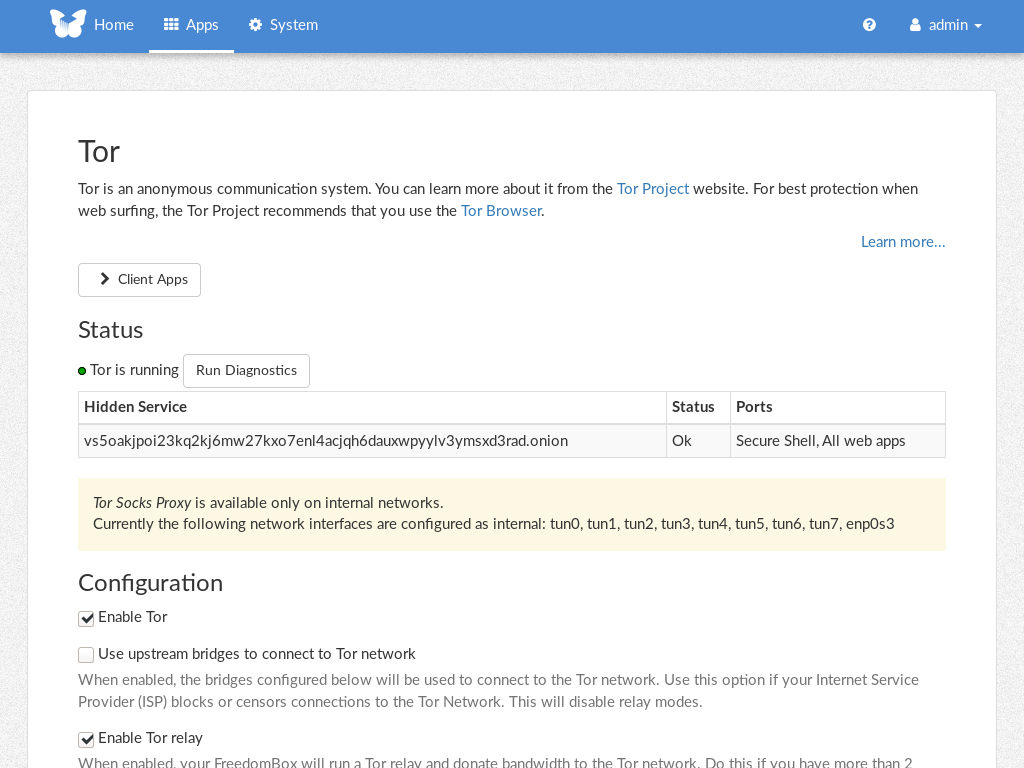
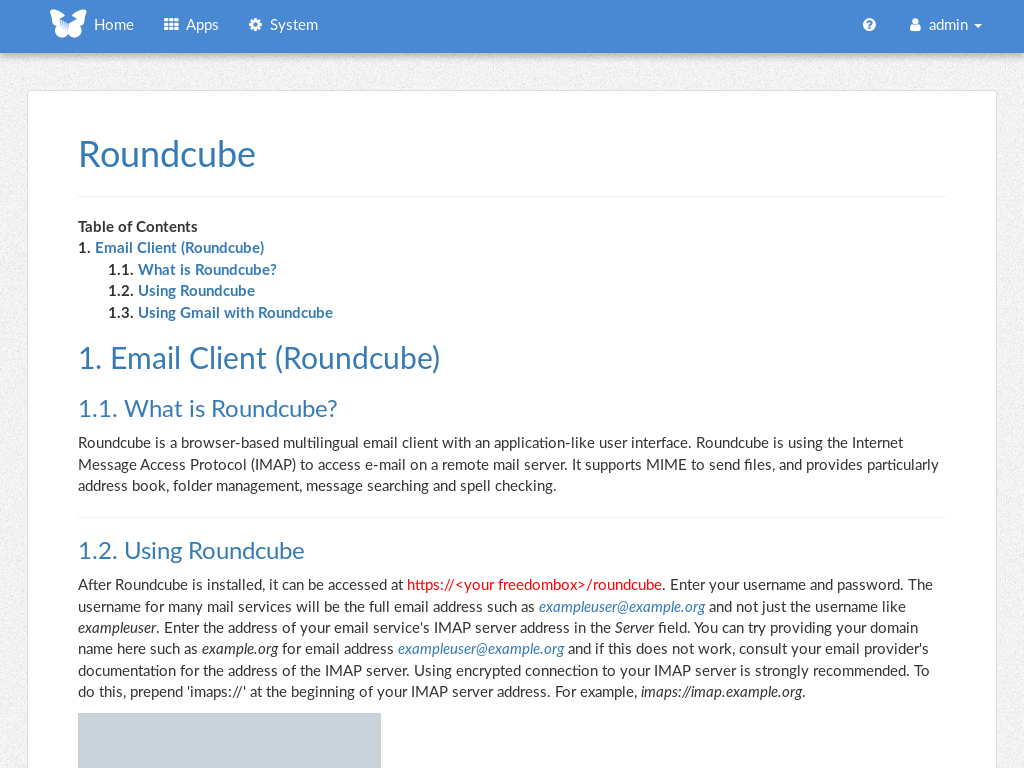
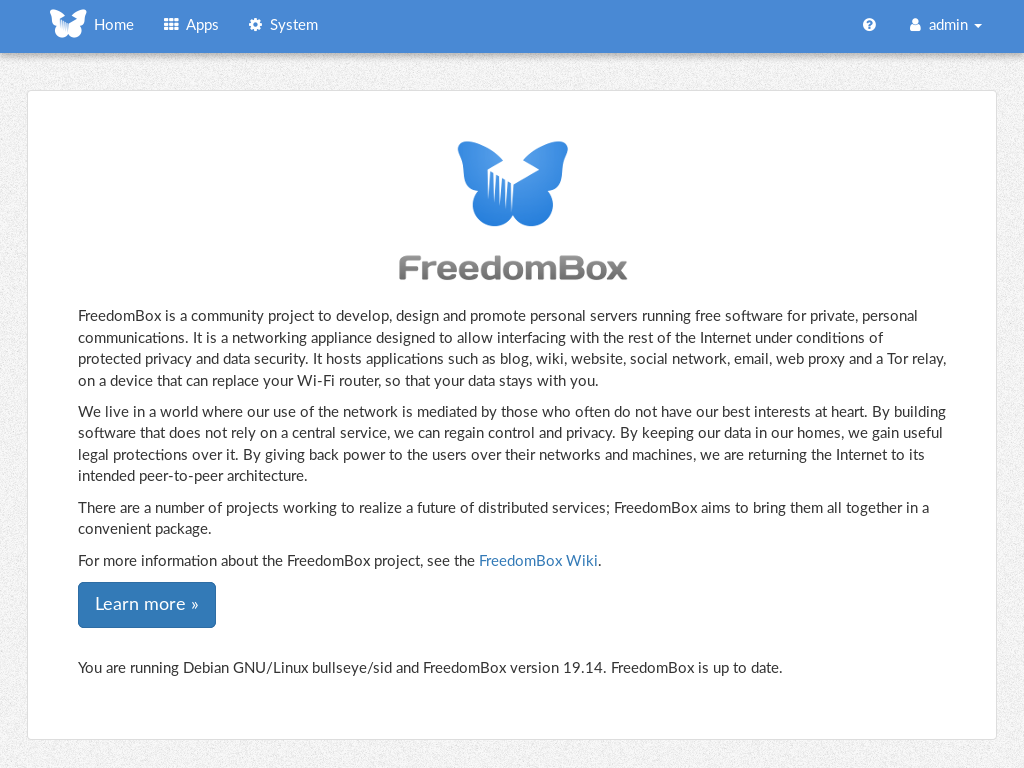
FreedomBox is a community project to develop, design and promote personal servers running free software for private, personal communications. It is a networking appliance designed to allow interfacing with the rest of the Internet under conditions of protected privacy and data security. It hosts applications such as blog, wiki, website, social network, email, web proxy and a Tor relay, on a device that can replace your Wi-Fi router, so that your data stays with you.
This module, called FreedomBox Service and also know as Plinth, is the core functionality and web interface to the functions of the FreedomBox. It is extensible and provides various applications of FreedomBox as modules. Each module or application provides simplified user interface to control the underlying functionality. As FreedomBox can act as a wireless router, it is possible to configure networking. It also allows configuration of basic system parameters such as time zone, hostname and automatic upgrades.
You can find more information about FreedomBox Service (Plinth) on the Plinth Wiki page, the FreedomBox Wiki and the FreedomBox Manual.
Getting Started
To have a running FreedomBox, first install Debian (Buster or higher) on a clean machine. Then run:
$ sudo apt install freedombox
Full instructions are available on FreedomBox Manual's QuickStart page.
For instructions on running the service on a local machine from source code, see INSTALL.md. For instructions on setting up for development purposes, see HACKING.md.
Contributing
See the HACKING.md file for contributing to FreedomBox Service (Plinth).
Localization