a0032856fd
- When running full diagnostics manually, we can use the Operation class. This
allows us to use many of its features.

  - Ensure only one task is running at any time. No need to use running_task
  global variable and a lock for it.

  - Don't run the operation if app install/uninstall or other potentially
  contentious tasks are running.

  - Since Operation object creates a thread, don't create another one with
  glib.schedule(). Don't wait unnecessarily for the operation to finish in the
  glib thread (or glib created thread).

- Since the app will show progress of operations when an operation is running,
it would not be possible to show progress of diagnostics running. So, create a
separate page for diagnostics results.

Tests:

- Run diagnostics and see redirection happens to diagnostics results page.
Results page shows ongoing tests. It refreshes automatically. When tests are
completed, 'Re-run diagnostics' button is shown.

- When visiting /diagnostics/full/ URL is visited without running the test. Only
the re-run button is shown. No results are shown. If tests have been run, re-run
button along with results are shown.

- On the app page, if the tests have been run, a button for viewing results is
shown. Otherwise, the button is not shown.

- In development mode, background diagnostics are run after 3 minutes (change
the time to 150 seconds if database locked errors show up). Results are
available in the results page.

- Make a diagnostic test fail by changing code or disabling a daemon. Run
diagnostics and notice that a notification is shown with the button to go to the
results. Clicking on the button shows the results page. Clicking dismiss removes
the notification.

Signed-off-by: Sunil Mohan Adapa <sunil@medhas.org>
Reviewed-by: James Valleroy <jvalleroy@mailbox.org>





FreedomBox Service (Plinth)
The core functionality and web front-end of FreedomBox.


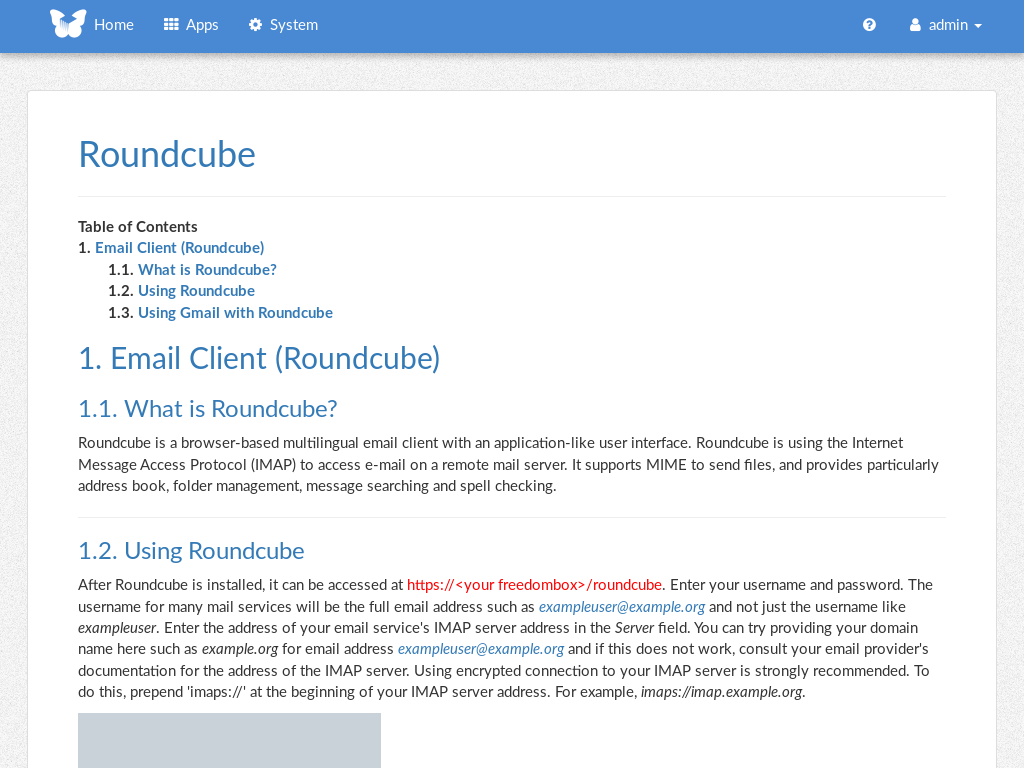

Description
FreedomBox is a community project to develop, design and promote personal servers running free software for private, personal communications. It is a networking appliance designed to allow interfacing with the rest of the Internet under conditions of protected privacy and data security. It hosts applications such as blog, wiki, website, social network, email, web proxy and a Tor relay, on a device that can replace your Wi-Fi router, so that your data stays with you.
This module, called FreedomBox Service and also know as Plinth, is the core functionality and web interface to the functions of the FreedomBox. It is extensible and provides various applications of FreedomBox as modules. Each module or application provides simplified user interface to control the underlying functionality. As FreedomBox can act as a wireless router, it is possible to configure networking. It also allows configuration of basic system parameters such as time zone, hostname and automatic upgrades.
You can find more information about FreedomBox Service (Plinth) on the Plinth Wiki page, the FreedomBox Wiki and the FreedomBox Manual.
Getting Started
To have a running FreedomBox, first install Debian (Buster or higher) on a clean machine. Then run:
$ sudo apt install freedombox
Full instructions are available on FreedomBox Manual's QuickStart page.
For instructions on running the service on a local machine from source code, see INSTALL.md. For instructions on setting up for development purposes, see HACKING.md.
Contributing
See the HACKING.md file for contributing to FreedomBox Service (Plinth).
Localization