 a998995f36
- Remove the first setup wizard step to run security upgrades. At the time of
its introduction, it was felt that this is very important. Some things have
changed since then:

  - We have mechanism for queuing package operations. Users can now trigger
  software updates and start installing apps before that is completed. Or vice
  versa. Earlier if the software updates were running, app install used to fail
  with an error.

  - There were no notifications. Since then we have added 'first setup'
  notification for important topics such as Privacy. This step can be replaced
  with a notification.

  - Automatic diagnostics and a diagnostic to notify of updated packages also
  helps bring attention to software updates if they are missed during first
  setup.

- A proposed change will re-introduce an advice to run updates in the 'Next
steps' wizard step along with a button trigger it right there.

- The new notification for software updates will bring more attention to running
updates as part of first setup.

- It would be nice not be stuck in the first setup wizard for a long period and
make it look simple. It improves the fun factor of setting up FreedomBox.

- It would present an opportunity to utilize the parallel installation of
apps/updates to the full extent. Although this can also be done by skipping the
progress step after updates are run.

- First wizard steps tend to get less testing.

Tests:

- Run the first setup wizard by removing /var/lib/plinth/plinth.sqlite3 and
running the service. Notice that the software update step is not shown and
wizard completes successfully.

- On stable container, backports step is shown as expected (if not already
enabled).

Signed-off-by: Sunil Mohan Adapa <sunil@medhas.org>
Reviewed-by: Veiko Aasa <veiko17@disroot.org>





FreedomBox Service (Plinth)
The core functionality and web front-end of FreedomBox.


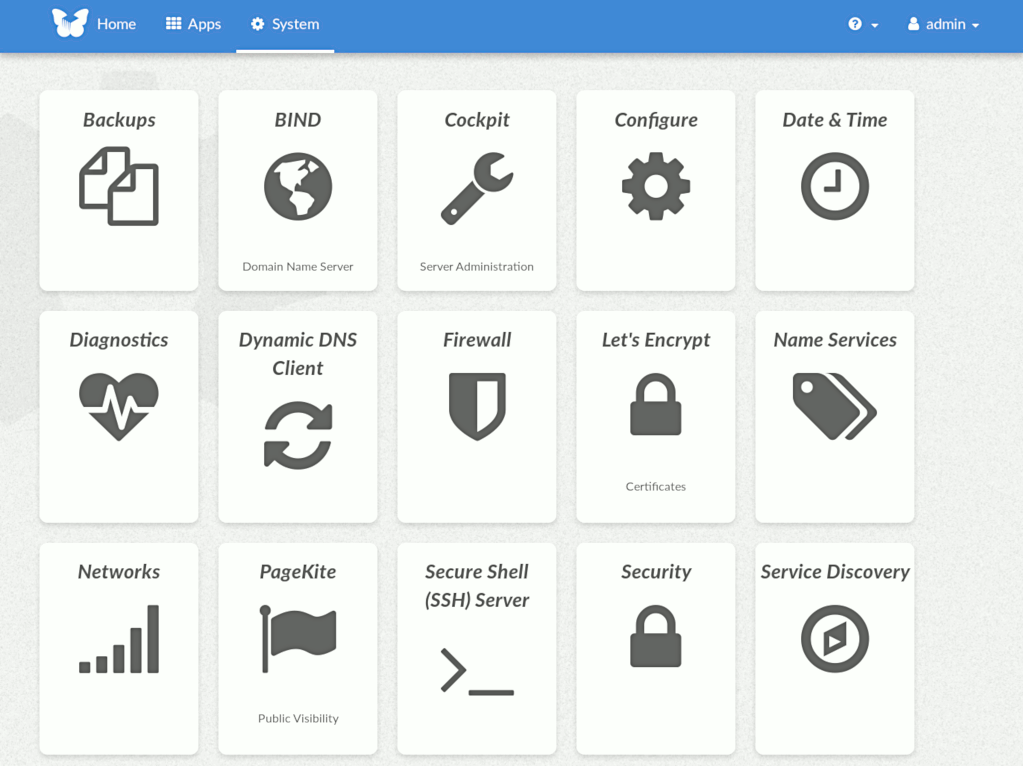


Description
FreedomBox is a community project to develop, design and promote personal servers running free software for private, personal communications. It is a networking appliance designed to allow interfacing with the rest of the Internet under conditions of protected privacy and data security. It hosts applications such as blog, wiki, website, social network, email, web proxy and a Tor relay, on a device that can replace your Wi-Fi router, so that your data stays with you.
This module, called FreedomBox Service and also know as Plinth, is the core functionality and web interface to the functions of the FreedomBox. It is extensible and provides various applications of FreedomBox as modules. Each module or application provides simplified user interface to control the underlying functionality. As FreedomBox can act as a wireless router, it is possible to configure networking. It also allows configuration of basic system parameters such as time zone, hostname and automatic upgrades.
You can find more information about FreedomBox Service (Plinth) on the Plinth Wiki page, the FreedomBox Wiki and the FreedomBox Manual.
Getting Started
To have a running FreedomBox, first install Debian (Buster or higher) on a clean machine. Then run:
$ sudo apt install freedombox
Full instructions are available on FreedomBox Manual's QuickStart page.
For instructions on running the service on a local machine from source code, see INSTALL.md. For instructions on setting up for development purposes, see HACKING.md.
Contributing
See the HACKING.md file for contributing to FreedomBox Service (Plinth).
Localization

License

FreedomBox is distributed under the GNU Affero General Public License, Version 3 or later. A copy of AGPLv3 is available from the Free Software Foundation.