 c2007d0f6d
- In current stable and testing, verifying SSH remote hosts using RSA is not
working. After selecting the verified RSA fingerprint, paramiko fails to connect

- A change introduced in paramiko 2.9 lead to failures when connecting to hosts
that have a verified RSA host key[1][2][3]. To fix the issue,
disabled_algorithms must be used to drop some of the other algorithms supported
by the server to force paramiko behavior. A better solution to the problem was
introduced in paramiko 3.2. Both these solutions require careful update to the
code. Considering the utility paramiko provides, the regression annoyance,
effort required for this fix, and the security implications (it is an completely
independent SSH implementation), the library does not seem to be worth the
effort in our case.

- Switch to using sshpass command line utility instead of paramiko library. The
only reason to use paramiko seems that 'ssh' command by default does not allow
us to input password easily while paramiko does.

- Another place where paramiko is being used is to check if a host is already
verified in the known_hosts file. This has been trivially replaced with
'ssh-keygen -F'.

- Exit codes provided by sshpass can replace the specific exception raised by
paramiko.

Links:

1) https://www.paramiko.org/changelog.html
2) https://github.com/paramiko/paramiko/issues/2017
3) https://github.com/paramiko/paramiko/issues/1984

Tests:

- Add a remote backup repository with and without encryption.

- Add remote backup repository with all three types of algorithms.

- Add a remote repository again with wrong password. Authentication error is
properly shown.

- Add a remote backup repository and remove it. Host remains verified. Add a
repository again.

- Add a remote backup repository and remove it. Host remains verified. Change
the fingerprint the /var/lib/plinth/.ssh/known_hosts file. Add a repository
again. A proper error is shown that remote host could not be verified.

- Add a remote backup repository and remove it. Host remains verified. Stop SSH
server on the remote host. A generic error is shown that ssh command on remote
host failed.

Signed-off-by: Sunil Mohan Adapa <sunil@medhas.org>
Reviewed-by: James Valleroy <jvalleroy@mailbox.org>





FreedomBox Service (Plinth)
The core functionality and web front-end of FreedomBox.
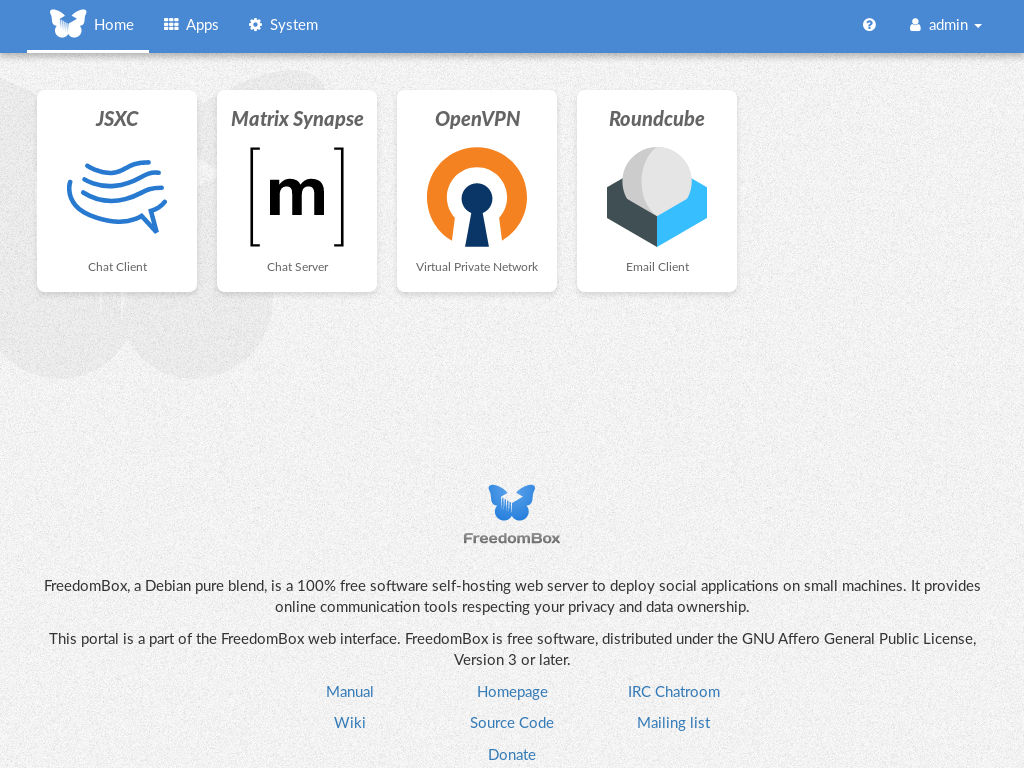


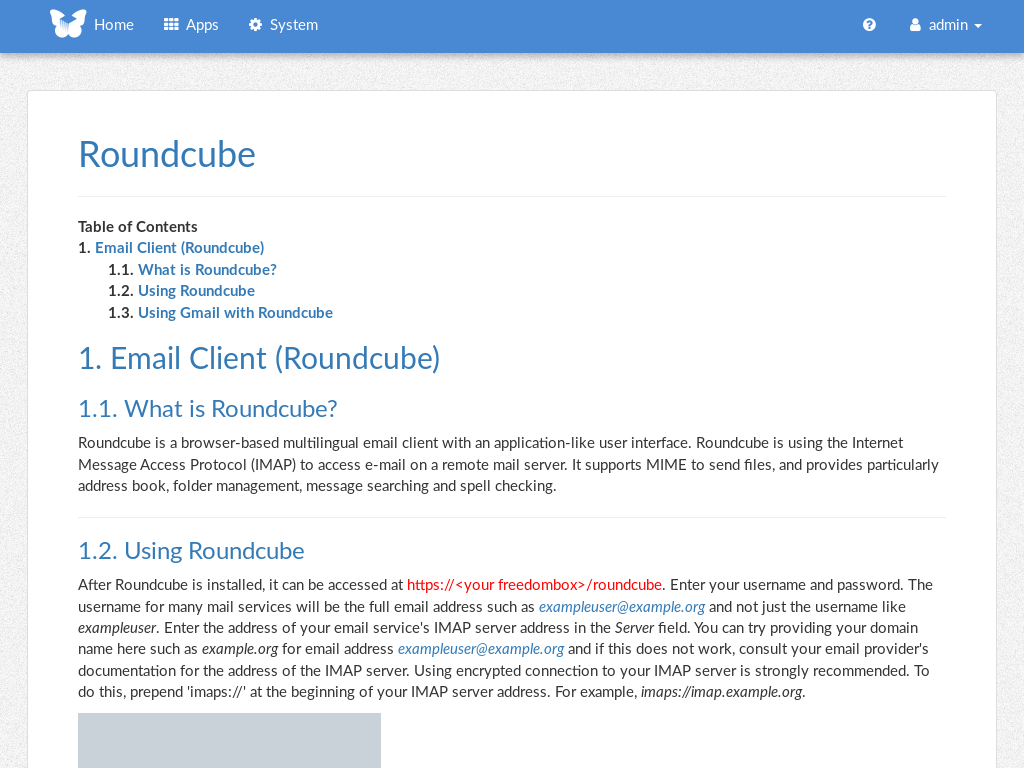

Description
FreedomBox is a community project to develop, design and promote personal servers running free software for private, personal communications. It is a networking appliance designed to allow interfacing with the rest of the Internet under conditions of protected privacy and data security. It hosts applications such as blog, wiki, website, social network, email, web proxy and a Tor relay, on a device that can replace your Wi-Fi router, so that your data stays with you.
This module, called FreedomBox Service and also know as Plinth, is the core functionality and web interface to the functions of the FreedomBox. It is extensible and provides various applications of FreedomBox as modules. Each module or application provides simplified user interface to control the underlying functionality. As FreedomBox can act as a wireless router, it is possible to configure networking. It also allows configuration of basic system parameters such as time zone, hostname and automatic upgrades.
You can find more information about FreedomBox Service (Plinth) on the Plinth Wiki page, the FreedomBox Wiki and the FreedomBox Manual.
Getting Started
To have a running FreedomBox, first install Debian (Buster or higher) on a clean machine. Then run:
$ sudo apt install freedombox
Full instructions are available on FreedomBox Manual's QuickStart page.
For instructions on running the service on a local machine from source code, see INSTALL.md. For instructions on setting up for development purposes, see HACKING.md.
Contributing
See the HACKING.md file for contributing to FreedomBox Service (Plinth).
Localization
License

FreedomBox is distributed under the GNU Affero General Public License, Version 3 or later. A copy of AGPLv3 is available from the Free Software Foundation.