 c5ec10d9cb
Sunil:

- When dovecot package is upgrade from 2.3 to 2.4 during distribution upgrade,
automatically re-run setup.

- Upgrade existing setups to new scheme by re-running setup with incremented app
version.

- Don't query dovecot version during app initialization. Instead overwrite the
DropinConfigs component to query dovecot version during setup and enable
operations.

- Use apt.Cache() to retrieve the installed version of dovecot package. Use
plinth.utils.Version to parse the version and perform a comparison.

- Split even configuration files that have not changed for simplicity.

- Add/update links in Dovecot configuration files.

Tests:

- Install email app on a testing container. Ensure that all files in
/etc/dovecot/conf.d/ are linked properly to 2.4 versions. TLS configuration is
accurate. Use Sogo to test login and sending mails.

  - User with LDAP account and correct password is able to login.

  - User without LDAP account or incorrect password is unable to login.

  - Send mail with Sogo to another account on the server. Notice that mails are
  stored in /var/mail/{user}/mail/ with mail:mail ownership in mbox format.

  - Logging in with email such as user@example.com works. Capital letters are
  allowed.

  - "Archive", "Drafts", "Sent", "Junk", "Trash" folders are automatically
  created and are marked with special flags. Creating additional folders such
  as "Sent Items" also results in them having special flags.

  - Thunderbird is able to connect via SSL with a self-signed certificate
  exception.

  - When an example spam message is sent, it is automatically moved to "Junk"
  folder after getting marked by rspamd.

  - When a message is moved to Junk folder, it is learned as spam by rspamd as
  seen in its admin console.

  - When a message is moved out of Junk folder (to other than "Trash" folder),
  it is learned as not-spam by rspamd as seen in its admin console.

- Install email app on a stable container with patches. Ensure that all files in
/etc/dovecot/conf.d/ are linked properly to 2.3 versions. TLS configuration is
accurate. Use Sogo to test login and sending mails.

- Install email app on a stable container without patches. Apply patches. Ensure
that all files in /etc/dovecot/conf.d/ are linked properly to 2.3 versions. TLS
configuration is accurate for dovecot 2.3. Use Sogo to test login and sending
mails. Perform distribution upgrade to testing. Ensure that all files in
/etc/dovecot/conf.d/ are linked properly to 2.3 versions. TLS configuration is
accurate for dovecot 2.4. Use Sogo to test login and sending mails.

Signed-off-by: Benedek Nagy <contact@nbenedek.me>
Signed-off-by: Sunil Mohan Adapa <sunil@medhas.org>
Reviewed-by: Sunil Mohan Adapa <sunil@medhas.org>





FreedomBox Service (Plinth)
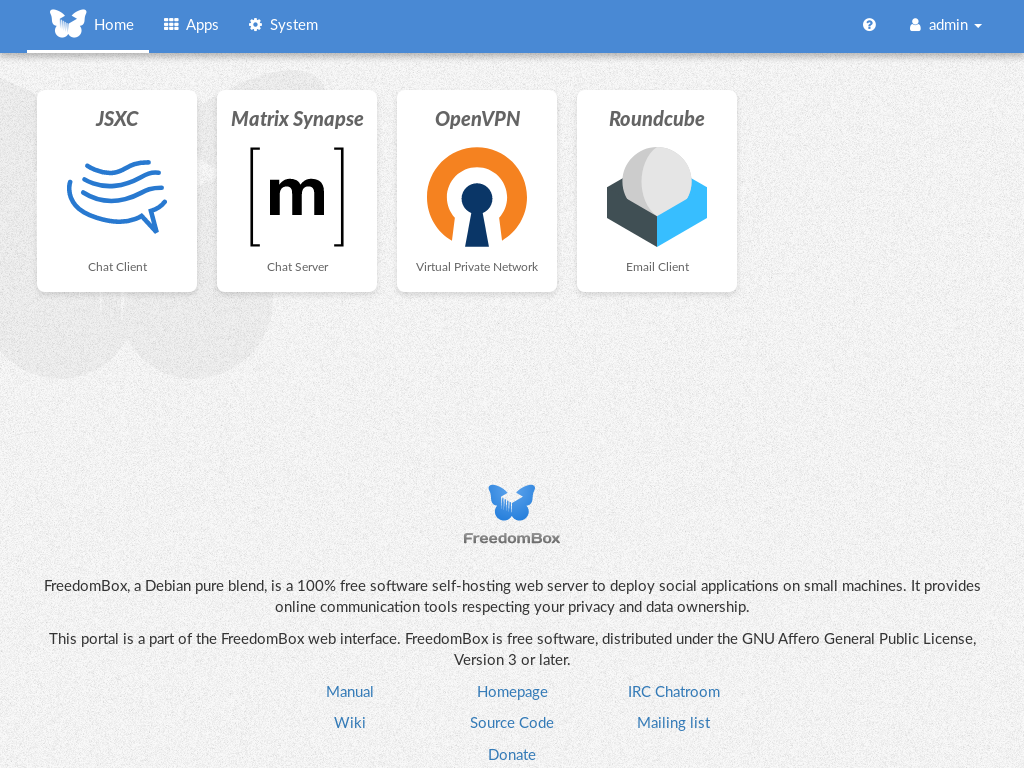
The core functionality and web front-end of FreedomBox.


Description
FreedomBox is a community project to develop, design and promote personal servers running free software for private, personal communications. It is a networking appliance designed to allow interfacing with the rest of the Internet under conditions of protected privacy and data security. It hosts applications such as blog, wiki, website, social network, email, web proxy and a Tor relay, on a device that can replace your Wi-Fi router, so that your data stays with you.
This module, called FreedomBox Service and also know as Plinth, is the core functionality and web interface to the functions of the FreedomBox. It is extensible and provides various applications of FreedomBox as modules. Each module or application provides simplified user interface to control the underlying functionality. As FreedomBox can act as a wireless router, it is possible to configure networking. It also allows configuration of basic system parameters such as time zone, hostname and automatic upgrades.
You can find more information about FreedomBox Service (Plinth) on the Plinth Wiki page, the FreedomBox Wiki and the FreedomBox Manual.
Getting Started
To have a running FreedomBox, first install Debian (Buster or higher) on a clean machine. Then run:
$ sudo apt install freedombox
Full instructions are available on FreedomBox Manual's QuickStart page.
For instructions on running the service on a local machine from source code, see INSTALL.md. For instructions on setting up for development purposes, see HACKING.md.
Contributing
See the HACKING.md file for contributing to FreedomBox Service (Plinth).
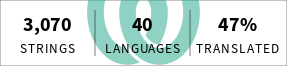
Localization
License

FreedomBox is distributed under the GNU Affero General Public License, Version 3 or later. A copy of AGPLv3 is available from the Free Software Foundation.