e04ae48637
- Handle groups needed by an app.
- Handle reserved usernames for an app.
- Updated documentation
- Updated unit tests

Tests performed:
  - Reserved usernames: ez-ipupd, ejabberd, Debian-minetest, mldonkey,
    monkeysphere, mumble-server, privoxy, quasselcore, radicale, debian-tor,
    debian-transmission
  - Reserved usernames checks should work in the following forms:
    - Create user
    - Update user
    - First boot user creation
  - Full list of available groups should appear in following cases:
    - Create user form
    - Update user form
  - Full list of groups should get created in Django DB during:
    - Update user form display
    - First boot form save
  - When updating the last admin user, the 'admin' group choice is checked
    and disabled.
  - Following groups show up (sorted by group name):
    - bit-torrent: Download files using BitTorrent applications
    - git-access: Read-write access to Git repositories
    - i2p: Manage I2P application
    - wiki: View and edit wiki applications
    - minidlna: Media streaming server
    - ed2k: Download files using eDonkey applications
    - freedombox-share: Access to the private shares
    - web-search: Search the web
    - syncthing: Administer Syncthing application
    - feed-reader: Read and subscribe to news feeds
    - admin: Access to all services and system settings
  - Directory validation form checks for write permissions for following apps:
    - deluge with debian-deluged user
    - transmission with debian-transmission user
  - Sharing app should show all the groups in add/edit share forms
  - The following apps should get added to share group during setup:
    debian-transmission
    debian-deluged
  - Unit tests pass
  - Functional tests for users and groups pass
  - Test that an app (example syncthing) provides the necessary
    permissions to users in that group (but not in admin group).

Signed-off-by: Joseph Nuthalapati <njoseph@riseup.net>
[sunil: Fix i18n of group descriptions]
[sunil: Update developer documentation]
[sunil: Separate out cosmetic changes]
[sunil: Fix component ID for mumble]
[sunil: sharing: Remove unneeded dependency on users app]
[sunil: Implement better API for getting groups in component]
[sunil: Fix incorrect regression change ttrss app]
[sunil: Make iterating over gourps more readable]
[sunil: Improve tests, drop single use fixtures]
[sunil: Simplify test_view.py fixture]
Signed-off-by: Sunil Mohan Adapa <sunil@medhas.org>
Tested-by: Sunil Mohan Adapa <sunil@medhas.org>
Reviewed-by: Sunil Mohan Adapa <sunil@medhas.org>
Reviewed-by: James Valleroy <jvalleroy@mailbox.org>





FreedomBox Service (Plinth)
The core functionality and web front-end of FreedomBox.



Description
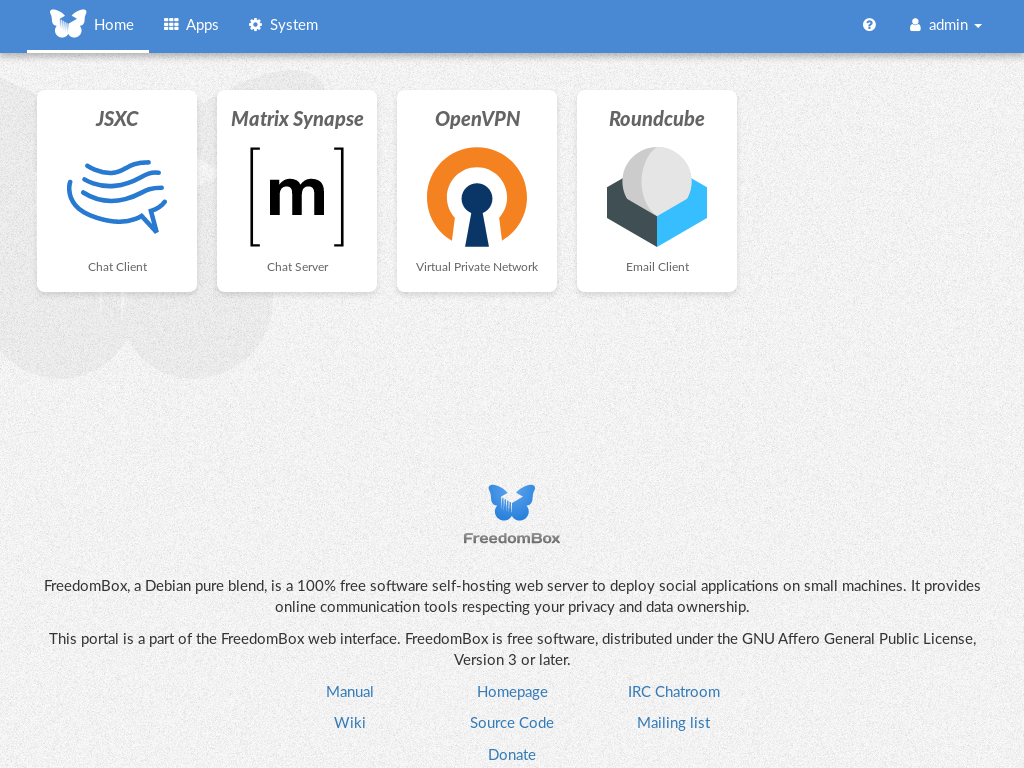
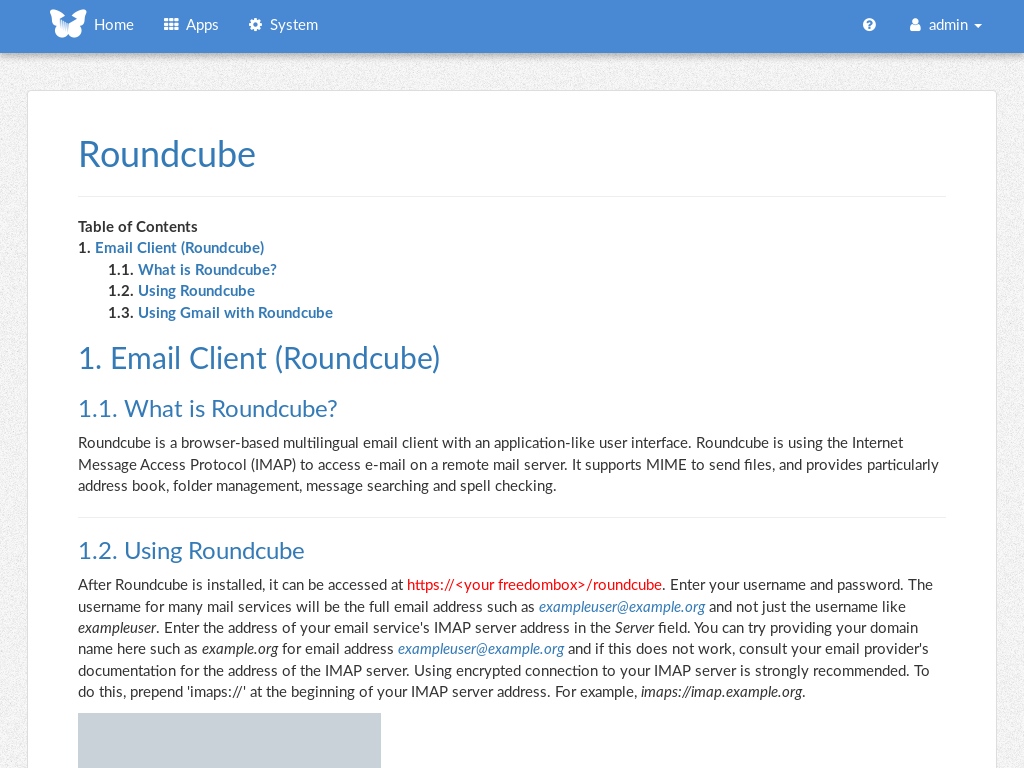
FreedomBox is a community project to develop, design and promote personal servers running free software for private, personal communications. It is a networking appliance designed to allow interfacing with the rest of the Internet under conditions of protected privacy and data security. It hosts applications such as blog, wiki, website, social network, email, web proxy and a Tor relay, on a device that can replace your Wi-Fi router, so that your data stays with you.
This module, called FreedomBox Service and also know as Plinth, is the core functionality and web interface to the functions of the FreedomBox. It is extensible and provides various applications of FreedomBox as modules. Each module or application provides simplified user interface to control the underlying functionality. As FreedomBox can act as a wireless router, it is possible to configure networking. It also allows configuration of basic system parameters such as time zone, hostname and automatic upgrades.
You can find more information about FreedomBox Service (Plinth) on the Plinth Wiki page, the FreedomBox Wiki and the FreedomBox Manual.
Getting Started
To have a running FreedomBox, first install Debian (Buster or higher) on a clean machine. Then run:
$ sudo apt install freedombox
Full instructions are available on FreedomBox Manual's QuickStart page.
For instructions on running the service on a local machine from source code, see INSTALL.md. For instructions on setting up for development purposes, see HACKING.md.
Contributing
See the HACKING.md file for contributing to FreedomBox Service (Plinth).
Localization