f7277cf465
Closes: #2085.

- Read the list of snapshots and properly determine the full subvolume name to
be used for mounting the .snapshots subvolume.

- Use systemd .mount units instead of editing fstab. Fstab editing is dangerous
and could result in system not booting properly. systemd units are better suited
for tool based editing while /etc/fstab is recommended for humans.

- Use automount feature provided by systemd using autofs to perform mounting. This
means that the backing filesystem is only accessed and mounted when the mount
point is accessed by a program. Parse errors in the mount/automount file and
incorrect mount parameters are also tolerated well with failure to boot.

Tests:

- On a fresh Debian Bullseye install with btrfs. Install FreedomBox with the
changes, create and delete manual snapshots. Rollback to a snapshot should also
work. /.snapshots should contain all the files inside each of the snapshots.

- After rebooting into a rolled back snapshot, create/delete and restore to a
snapshot should work. /.snapshots should contain all the files inside each of
the snapshots.

- Introduce an error in .mount file such the mount operation will fail. Reboot
the machine. Reboot is successful. /.snapshots is still mounted as autofs.
Trying to access /.snapshots will result in error during mount operation.

- On a vagrant box without changes. Install freedombox and ensure snapshot app
setup has been run. This creates the /etc/fstab entry. Apply the patches.
snapshot app will run and remove the mount line in /etc/fstab and create the
.mount entry. /.snapshots is still mounted but not because of .automount. After
reboot, /.snapshots is mounted with autofs and also with btrfs. Unmounting
/.snapshots and then trying to run 'ls /.snapshots' will perform the mount again.

Signed-off-by: Sunil Mohan Adapa <sunil@medhas.org>
Reviewed-by: James Valleroy <jvalleroy@mailbox.org>





FreedomBox Service (Plinth)
The core functionality and web front-end of FreedomBox.



Description
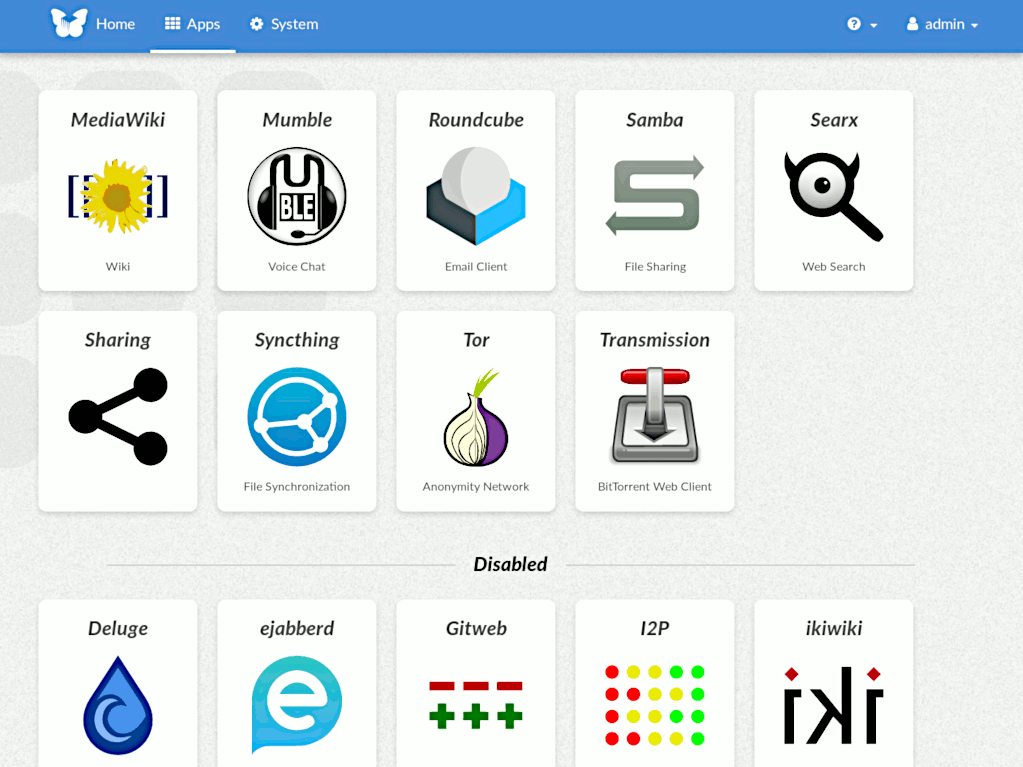
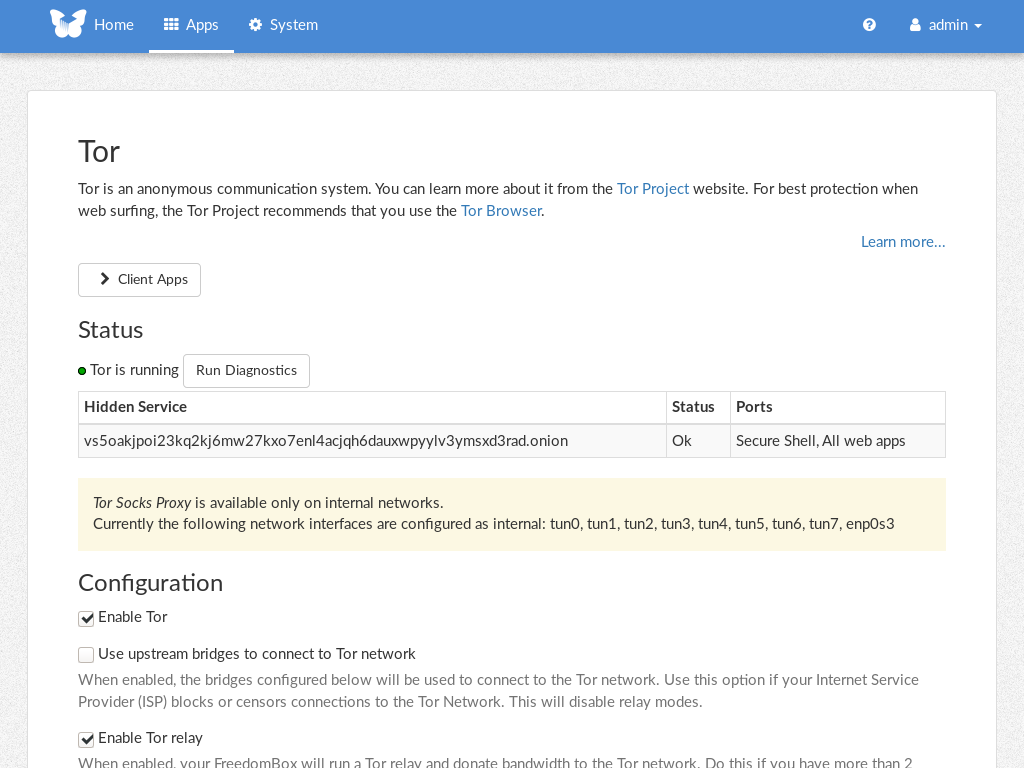
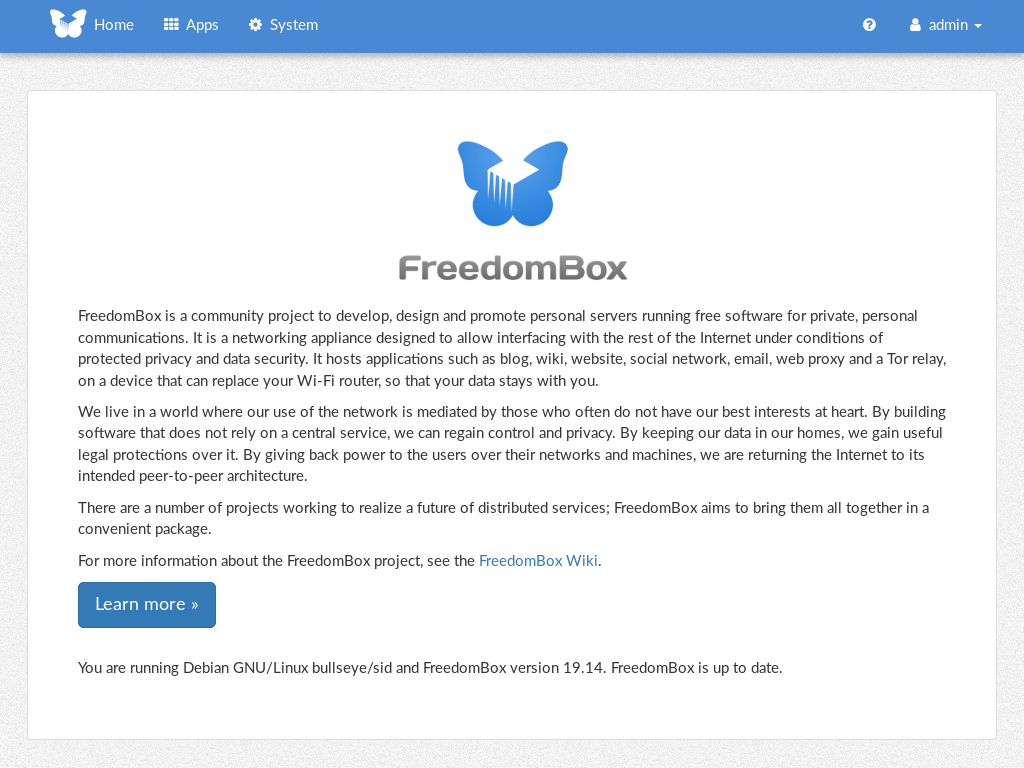
FreedomBox is a community project to develop, design and promote personal servers running free software for private, personal communications. It is a networking appliance designed to allow interfacing with the rest of the Internet under conditions of protected privacy and data security. It hosts applications such as blog, wiki, website, social network, email, web proxy and a Tor relay, on a device that can replace your Wi-Fi router, so that your data stays with you.
This module, called FreedomBox Service and also know as Plinth, is the core functionality and web interface to the functions of the FreedomBox. It is extensible and provides various applications of FreedomBox as modules. Each module or application provides simplified user interface to control the underlying functionality. As FreedomBox can act as a wireless router, it is possible to configure networking. It also allows configuration of basic system parameters such as time zone, hostname and automatic upgrades.
You can find more information about FreedomBox Service (Plinth) on the Plinth Wiki page, the FreedomBox Wiki and the FreedomBox Manual.
Getting Started
To have a running FreedomBox, first install Debian (Buster or higher) on a clean machine. Then run:
$ sudo apt install freedombox
Full instructions are available on FreedomBox Manual's QuickStart page.
For instructions on running the service on a local machine from source code, see INSTALL.md. For instructions on setting up for development purposes, see HACKING.md.
Contributing
See the HACKING.md file for contributing to FreedomBox Service (Plinth).
Localization