09022b4bd2
* refactor(jellyfin): inject core/sonic into the Jellyfin Router

* feat(jellyfin): add AudioMuse /info endpoint

* feat(jellyfin): add AudioMuse /similar_tracks endpoint

* feat(jellyfin): gate AudioMuse endpoints on sonic provider

* feat(jellyfin): add AudioMuse /find_path endpoint

* fix(jellyfin): fix case-insensitive route collision across positions

canonicalRouteSegments keyed canonical case by lower-cased segment name
alone, globally. Two unrelated routes sharing a segment name with
different casing at different tree depths (e.g. "Info" in
/System/Info/Public vs "info" in /AudioMuseAI/info) silently overwrote
each other, 404-ing the loser even for exact-case requests. Replace the
flat map with a position-aware trie mirroring the routing tree.

* test(jellyfin): e2e tests for AudioMuse endpoints

* docs(jellyfin): document AudioMuse compatibility endpoints

* test(jellyfin): harden AudioMuse tests and doc note (final-review follow-ups)

- Comment-lock the []string{} (not nil) contract for /AudioMuseAI/info's
  AvailableEndpoints so it keeps serializing as [] rather than null, and
  add a raw-body assertion to the existing empty-list test to catch a
  regression a struct-only unmarshal can't detect.
- Cover the previously-untested engine-error branch in similar_tracks and
  find_path, both of which degrade to an empty result.
- Document that find_path's path/total_distance only reflect hops through
  libraries the caller can access in multi-library setups.

* refactor(jellyfin): dedup AudioMuse test request helper, presize dedup map

* refactor(sonic): expose sonic.Engine interface; drop typed-nil guard in jellyfin.New

The Jellyfin Router's sonic field was an interface but New() took the concrete
*sonic.Sonic, so a nil arg became a non-nil typed-nil and needed a guard — the
only injected dependency that did. Move the interface (sonic.Engine) beside its
implementation, take it in New() like every other service, and bind it in wire.

* refactor(jellyfin): case-insensitive routing via lowercased paths

Replace the position-aware route trie with a trivial middleware that lowercases
the request path, and register every route in lowercase. Simpler, and no segment
name can collide across positions. caseInsensitivePaths moves into middlewares.go
alongside normalizeQueryKeys. Relies on the invariant that no Jellyfin path segment
carries case-sensitive data (all ids are lowercase hex via dto.EncodeID).

* feat(jellyfin): add AudioMuse /health endpoint

A liveness probe matching the reference plugin: 200 with an empty body when a
SonicSimilarity provider is loaded, 404 otherwise. /AudioMuseAI/info now
advertises it (list alphabetized like the plugin's OrderBy).

Also trims the AudioMuse and case-insensitive-routing comments to their essential
rationale.

* fix(jellyfin): hex-encode user IDs so lowercased paths stay valid

Address PR review: user IDs were the one id the Jellyfin API emitted raw (base62,
uppercase-capable), so lowercasing request paths could alter a userId segment. Encode
them via dto.EncodeID like every other id, making the 'all boundary ids are lowercase
hex' invariant true — no routing special-casing needed. Also caps user-controlled n /
max_steps, fixes the songAgent test comment, and adds leading slashes to the README
endpoint list.

Navidrome Music Server 








Navidrome is an open source web-based music collection server and streamer. It gives you freedom to listen to your music collection from any browser or mobile device. It's like your personal Spotify!
Note: The master branch may be in an unstable or even broken state during development.
Please use releases instead of
the master branch in order to get a stable set of binaries.
Check out our Live Demo!
Any feedback is welcome! If you need/want a new feature, find a bug or think of any way to improve Navidrome, please file a GitHub issue or join the discussion in our Subreddit. If you want to contribute to the project in any other way (ui/backend dev, translations, themes), please join the chat in our Discord server.
Installation
See instructions on the project's website
Cloud Hosting
PikaPods has partnered with us to offer you an officially supported, cloud-hosted solution. A share of the revenue helps fund the development of Navidrome at no additional cost for you.

Features
- Handles very large music collections
- Streams virtually any audio format available
- Reads and uses all your beautifully curated metadata
- Great support for compilations (Various Artists albums) and box sets (multi-disc albums)
- Multi-user, each user has their own play counts, playlists, favourites, etc...
- Very low resource usage
- Multi-platform, runs on macOS, Linux and Windows. Docker images are also provided
- Ready to use binaries for all major platforms, including Raspberry Pi
- Automatically monitors your library for changes, importing new files and reloading new metadata
- Supports lyrics from sidecar .ttml, .yaml/.yml Lyricsfile, .elrc, .lrc, .srt, .txt files and embedded TTML, Enhanced LRC, LRC, SRT, and plain-text tags (via
lyricspriority) - Themeable, modern and responsive Web interface based on Material UI
- Compatible with all Subsonic/Madsonic/Airsonic clients
- Transcoding on the fly. Can be set per user/player. Opus encoding is supported
- Translated to various languages
Translations
Navidrome uses POEditor for translations, and we are always looking for more contributors
Documentation
All documentation can be found in the project's website: https://www.navidrome.org/docs. Here are some useful direct links:
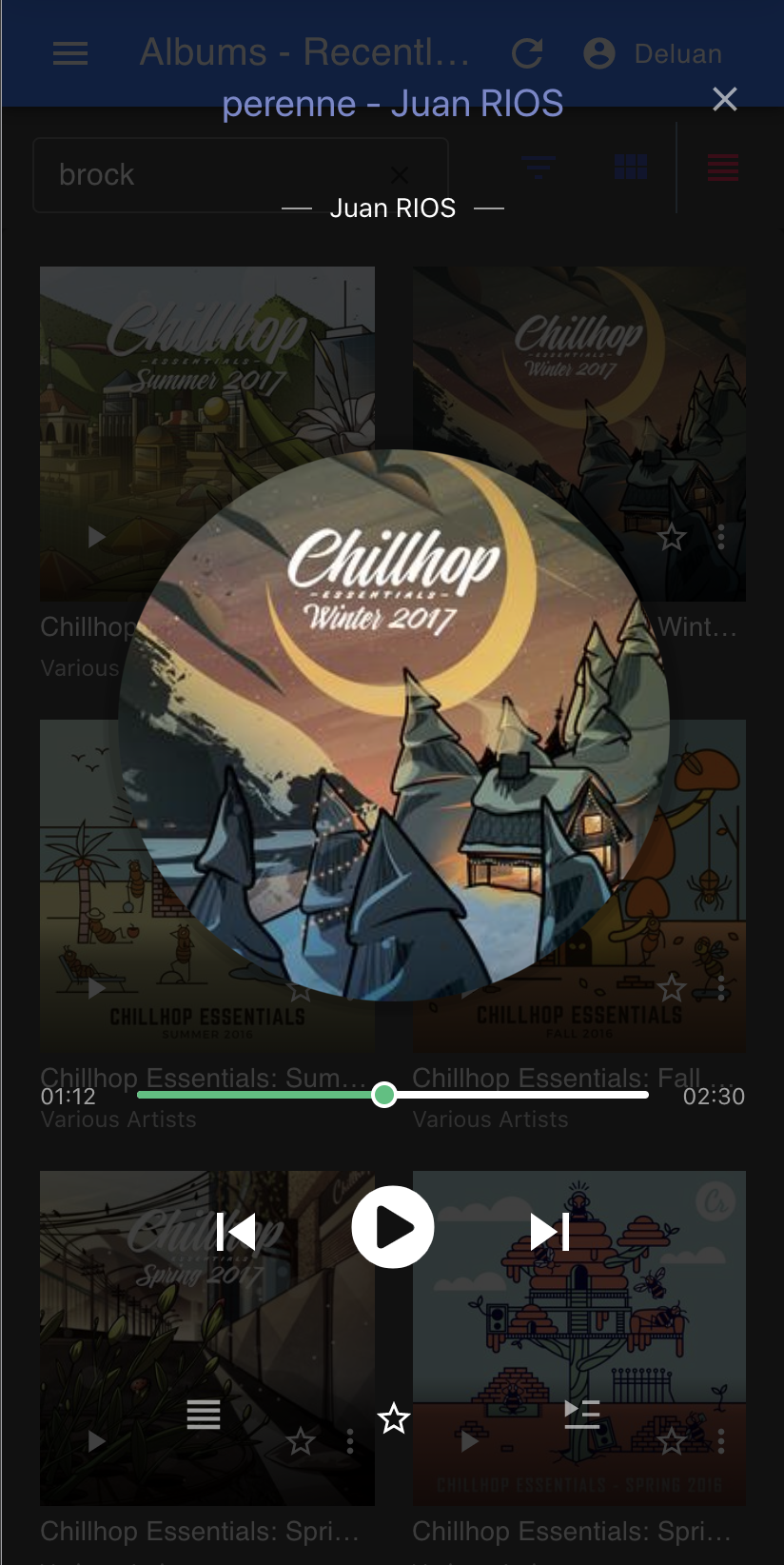
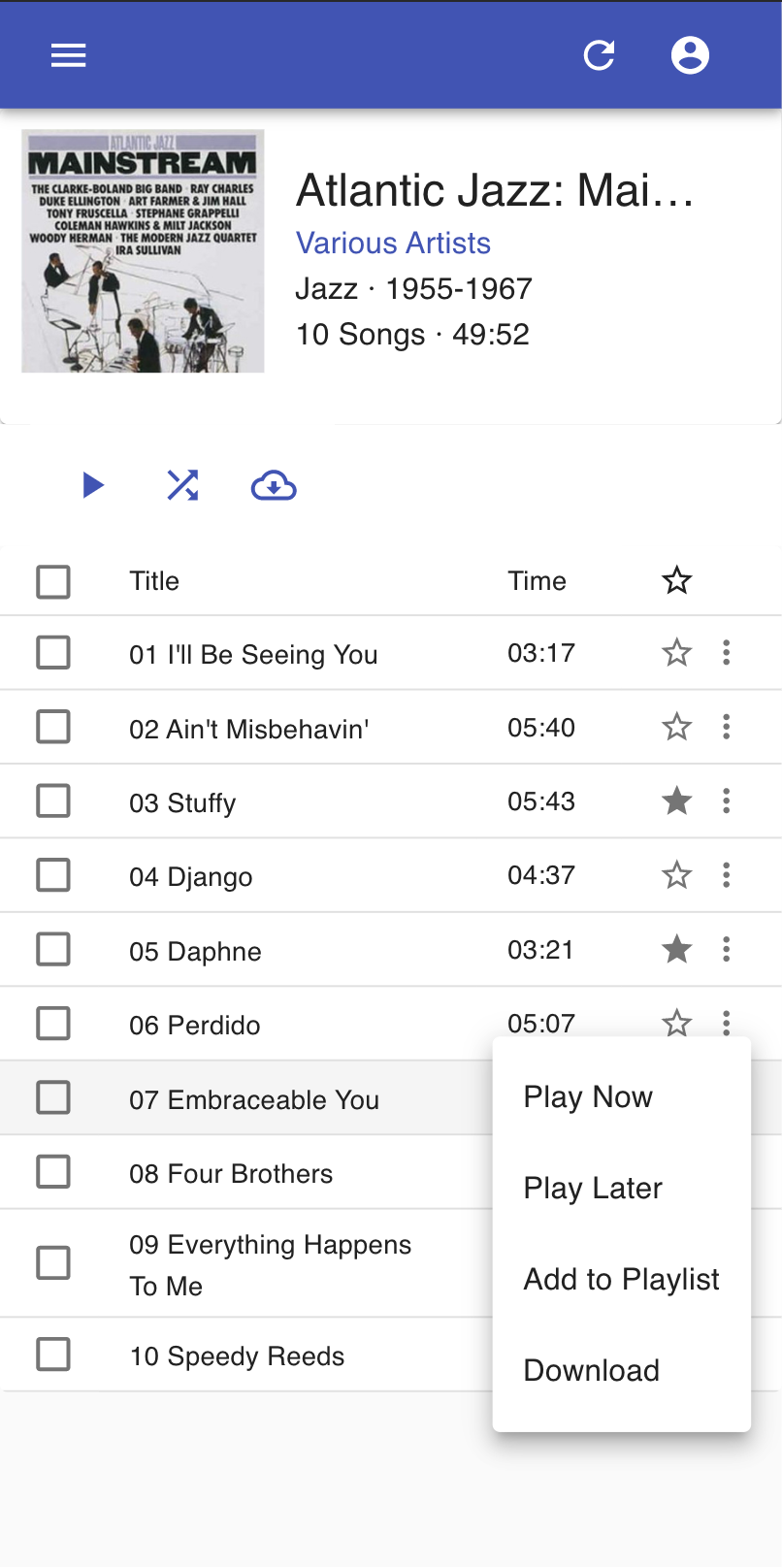
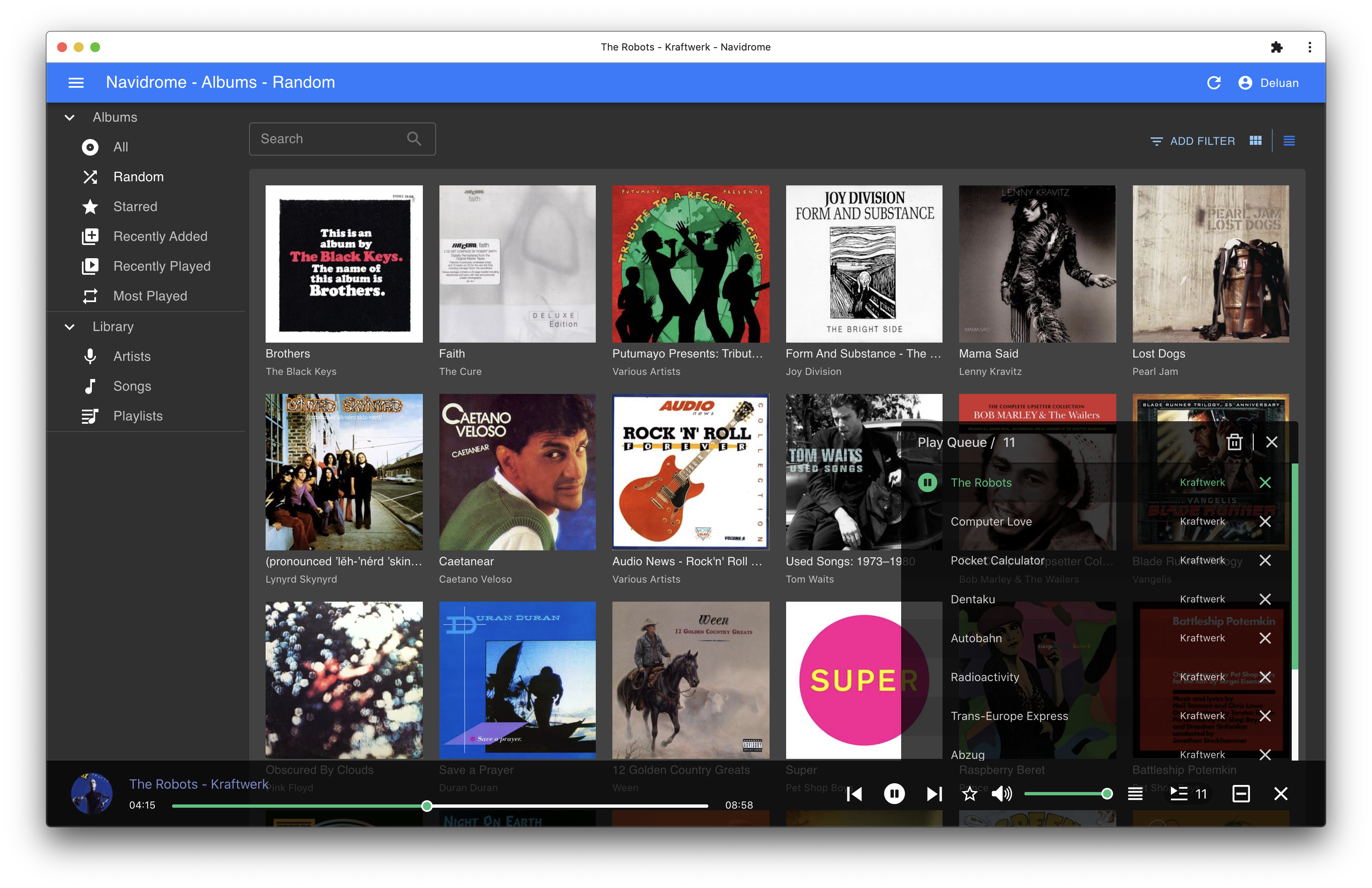
Screenshots