24311918c7
* fix(artwork): ramp the external circuit breaker back up instead of closing on one answer

The breaker went straight from open to fully closed on a single non-transient response,
so recovery was a burst: the agent resumed at the limiter's full rate until five
consecutive failures reopened it. A not-found counted as that response, and a provider
that is blocking still answers the occasional request, so the cycle never settled.

Observed on a production library over 100 minutes with apple-music blocked. Of 232
responses, 228 were 403 and 4 were not-found, and those four closed the breaker four
times. Each close was followed by another open 1 to 3 seconds later, with about five
requests in between:

  00:59:05 closed -> 00:59:06 opened
  01:23:13 closed -> 01:23:16 opened
  01:41:21 closed -> 01:41:24 opened

Closing now needs breakerRecoveries consecutive answers, one per probe interval, and any
failure discards the count. A not-found still counts, because the provider did answer, but
it can no longer close the breaker by itself.

Unrelated to the plugin loading in the rest of this PR; it came out of investigating why
iTunes kept returning 403 while the breaker was open.

* fix(artwork): count only current-episode probes toward breaker recovery

The worker drains concurrently, so when the breaker opens there are already calls past
allow(), queued in the rate limiter or waiting on a response. Their answers arrive after
the open and reached the recovery counter, so breakerRecoveries of them closed the breaker
with no probe interval elapsed at all: the burst the ramp exists to prevent.

allow() now returns the open episode a call was admitted under, zero when the breaker was
closed, and only an answer whose generation matches the current episode counts. The
generation also invalidates a probe whose answer lands after the breaker closed and
reopened, which a plain probe flag would credit to the wrong episode.

The token never crosses the gateFunc seam: allow and record are both called inside
Worker.gate, so passthroughGate, tracingGate and offlineGate are untouched.

The regression test needs no fake clock. The race is an ordering, not a duration, so it is
reproduced by calling allow and record in the order concurrency produces, which is
deterministic where a goroutine-based test would pass on a lucky schedule.

Found by Codex.

* test(artwork): move the breaker ordering spec into the Ginkgo suite

The ordering regression does not need a fake clock, so it does not need the plain
testing.T runner either. That runner is only used here because testing/synctest requires
it; every other spec belongs in the Ginkgo suite.

The three specs left in worker_timing_test.go all drive the fake clock.

Navidrome Music Server 








Navidrome is an open source web-based music collection server and streamer. It gives you freedom to listen to your music collection from any browser or mobile device. It's like your personal Spotify!
Note: The master branch may be in an unstable or even broken state during development.
Please use releases instead of
the master branch in order to get a stable set of binaries.
Check out our Live Demo!
Any feedback is welcome! If you need/want a new feature, find a bug or think of any way to improve Navidrome, please file a GitHub issue or join the discussion in our Subreddit. If you want to contribute to the project in any other way (ui/backend dev, translations, themes), please join the chat in our Discord server.
Installation
See instructions on the project's website
Cloud Hosting
PikaPods has partnered with us to offer you an officially supported, cloud-hosted solution. A share of the revenue helps fund the development of Navidrome at no additional cost for you.

Features
- Handles very large music collections
- Streams virtually any audio format available
- Reads and uses all your beautifully curated metadata
- Great support for compilations (Various Artists albums) and box sets (multi-disc albums)
- Multi-user, each user has their own play counts, playlists, favourites, etc...
- Very low resource usage
- Multi-platform, runs on macOS, Linux and Windows. Docker images are also provided
- Ready to use binaries for all major platforms, including Raspberry Pi
- Automatically monitors your library for changes, importing new files and reloading new metadata
- Supports lyrics from sidecar .ttml, .yaml/.yml Lyricsfile, .elrc, .lrc, .srt, .txt files and embedded TTML, Enhanced LRC, LRC, SRT, and plain-text tags (via
lyricspriority) - Themeable, modern and responsive Web interface based on Material UI
- Compatible with all Subsonic/Madsonic/Airsonic clients
- Transcoding on the fly. Can be set per user/player. Opus encoding is supported
- Translated to various languages
Translations
Navidrome uses POEditor for translations, and we are always looking for more contributors
Documentation
All documentation can be found in the project's website: https://www.navidrome.org/docs. Here are some useful direct links:
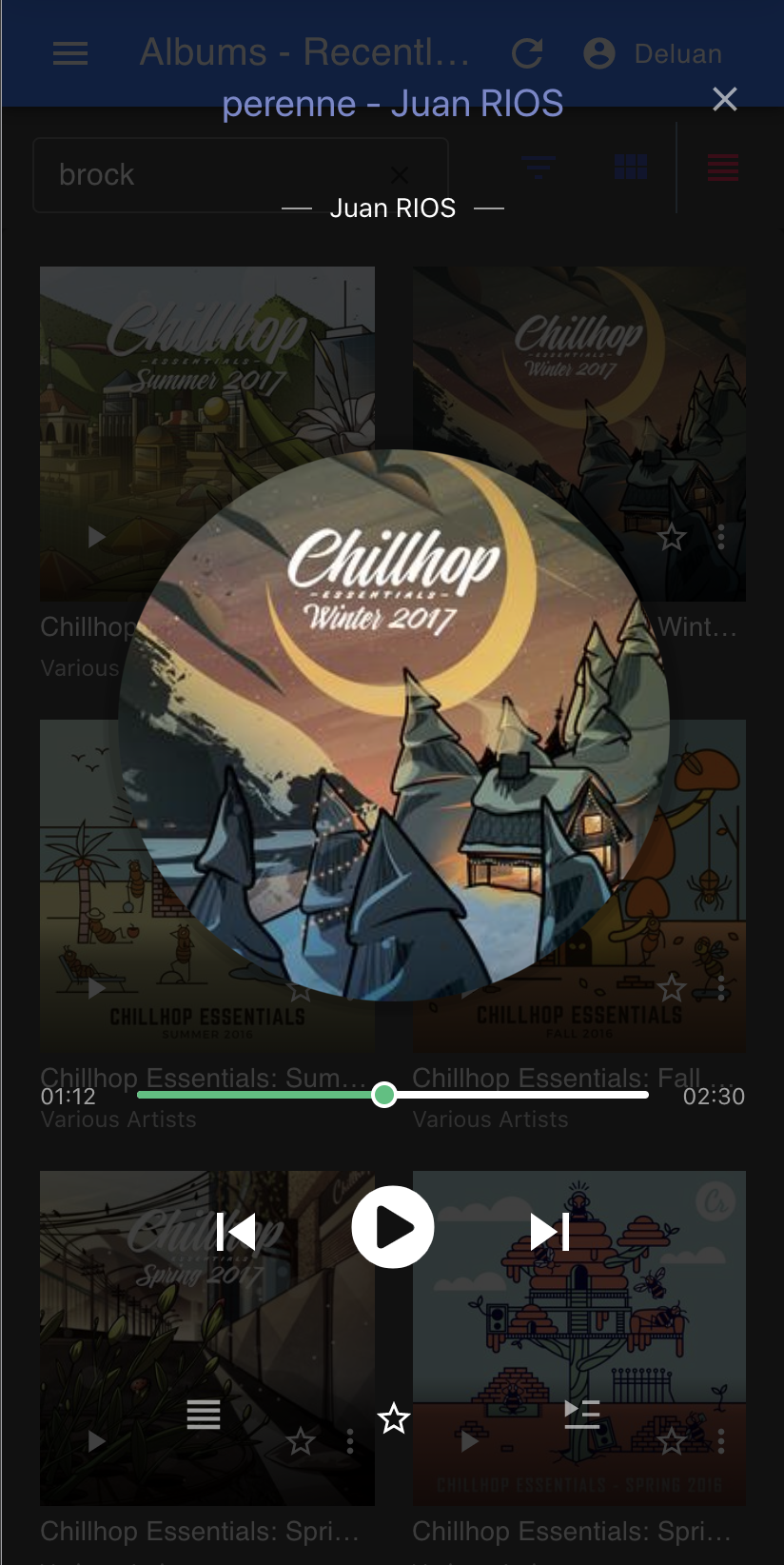
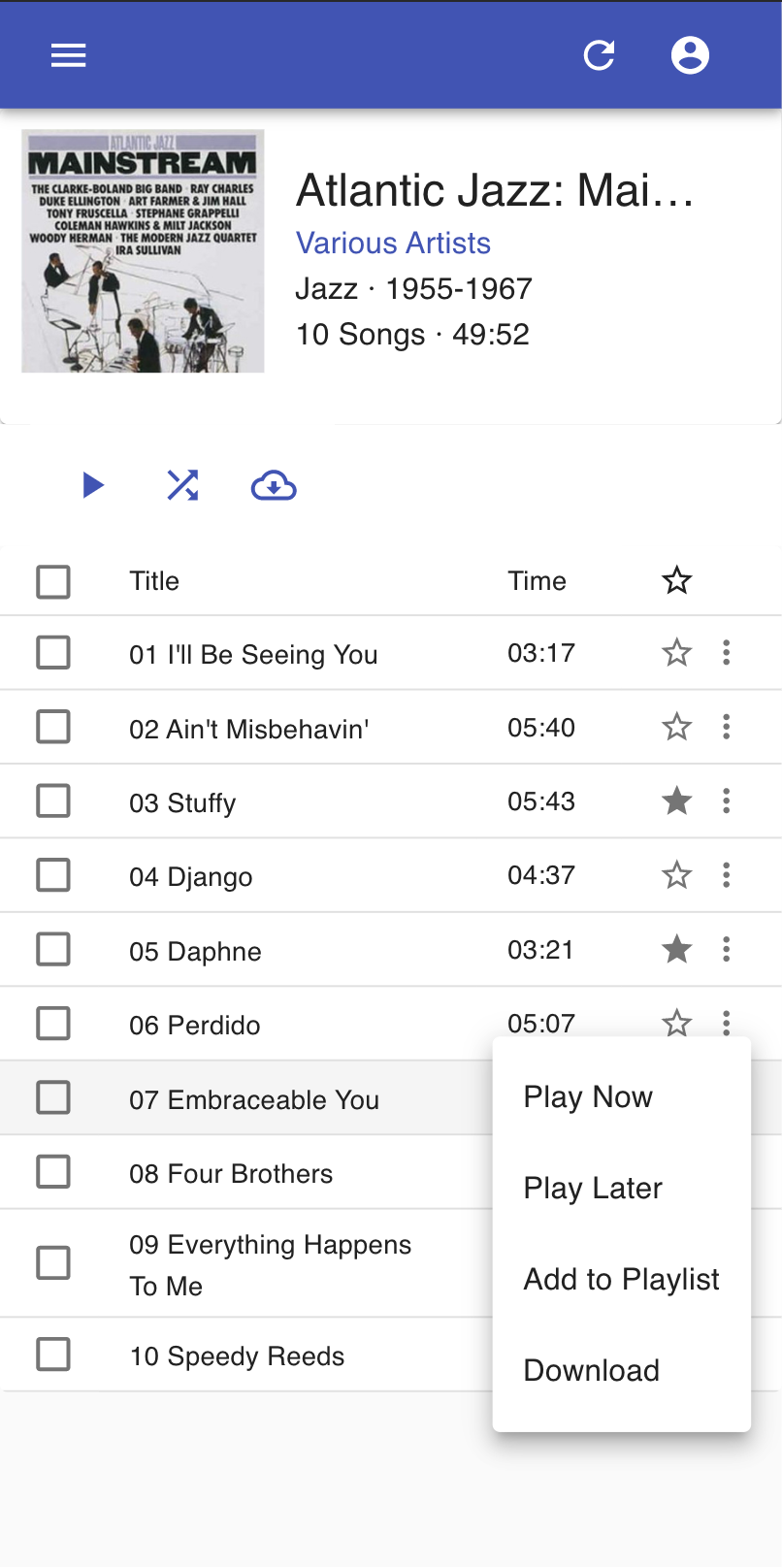
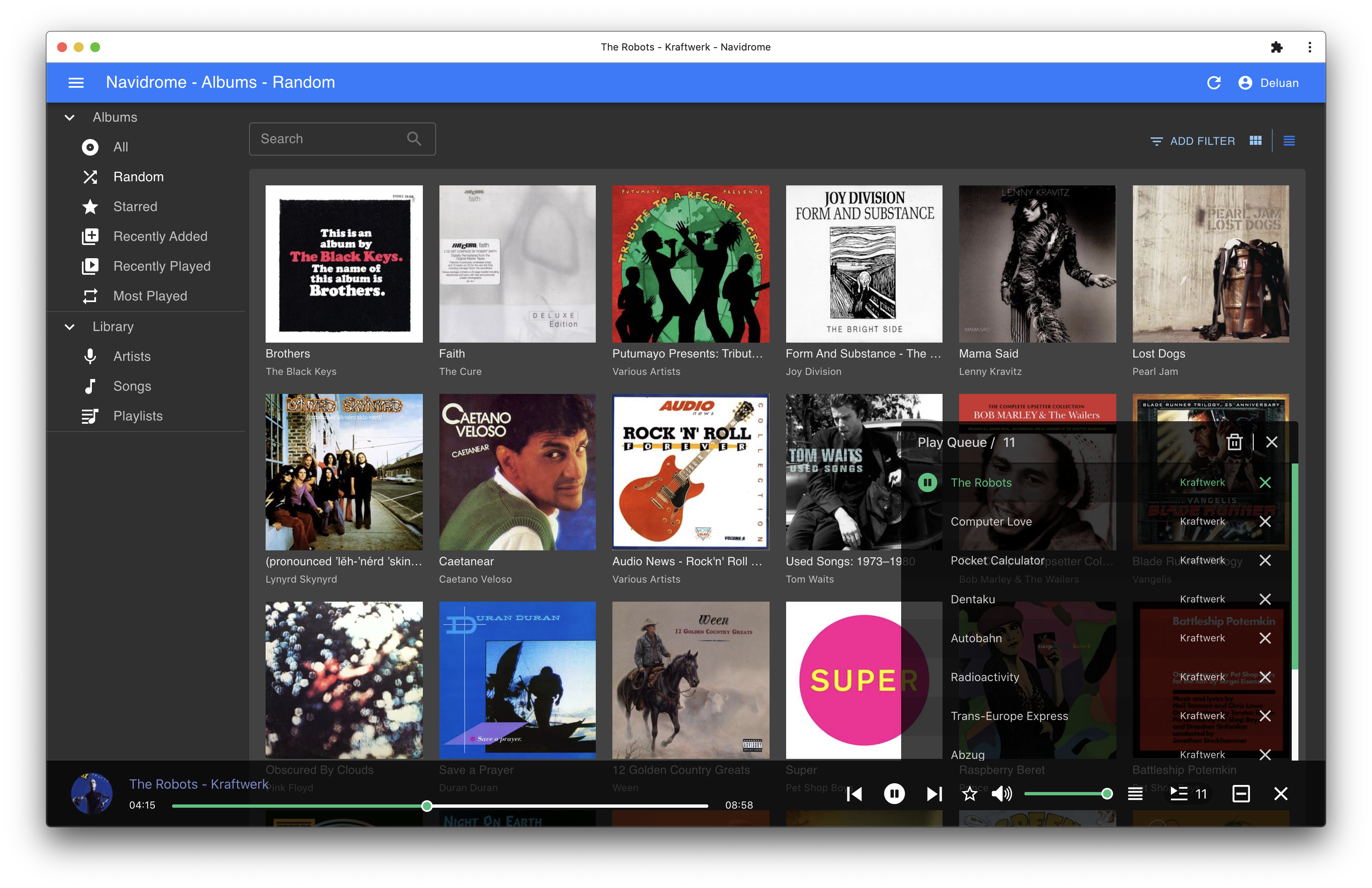
Screenshots