5b758fc20c
* fix(artwork): re-resolve artwork when image files change on disk

An image-only folder change (replaced, added, or deleted cover/artist
images, with no audio files touched) was detected by the scanner but never
reached the artwork queue, so clients kept seeing the old coverArt hash
until something else forced a re-resolution.

Phase 1 now diffs each changed folder's image list and imagesUpdatedAt
against the previously persisted folder row, and at the end of the phase
bulk-enqueues re-resolution for the affected entities: albums with tracks
in the folder or its direct children (covering disc subfolder layouts),
and, when an artist-pattern image is involved, artists with albums under
the folder's subtree, mirroring the artist resolver's upward search. The
artist mapping mirrors the resolver's sole-album-artist album selection.

New repository helpers keep the mapping set-based and light: folder
GetAllIDs, media_file GetAlbumIDsByFolder (distinct, indexed by
folder_id), and album GetSoleAlbumArtistIDs.

* refactor: simplify the image-change artwork enqueue after review

Load the previous folder image state through the existing GetFolderUpdateInfo
bulk pre-pass instead of a per-folder SELECT inside the persist transaction,
and skip the diff for new folders, whose artwork the scanner already enqueues
inline. Move the artist-image classification into core/artwork
(IsArtistImageFile) so the scanner shares the resolver's ArtistArtPriority
token grammar instead of re-parsing it (the copy mistreated image-folder as a
filename glob). Move the folder-subtree query into the folder repository
(GetSubtreeIDs) with LIKE escaping and expression-tree batching, share the
sole-album-artist predicate between the resolver and the album repository
(model.SoleAlbumArtistFilter), extract a chunked single-column query helper,
and deduplicate the ArtworkQueueItem literals behind scanArtworkItem.

* fix(persistence): keep slash-form paths in GetSubtreeIDs subtree predicates

The scanner hands GetSubtreeIDs io/fs slash-form paths, but filepath.Clean
rewrites them with backslashes on Windows while folder.path is stored with
forward slashes, so the descendant predicates matched nothing and nested
artist folders were never re-enqueued there. Normalize with path.Clean, like
HasAudioOutsideFolders does, and cover a nested path in the repo test.

* refactor(persistence): move the sole-album-artist rule into the album repository

SQLizer filters belong in the persistence package, not model. The rule
becomes an unexported filter shared by GetSoleAlbumArtistIDs and a new
GetBySoleAlbumArtist repository method, which the artist artwork resolver now
calls instead of building the squirrel filter itself.

* perf(scanner): resolve image-change artists in one query over album.folder_ids

The artist half of the image-change enqueue walked folder subtree IDs, then
media_file rows, then album rows, marshalling thousands of bound IDs through
the driver on each hop. Matching albums by their own folder_ids instead is one
statement, and folder_ids is the same source the artist resolver uses to
compute an artist's folders.

Benchmarked against a copy of the production DB (97k tracks, 10k folders,
7k albums): 87ms +/-196% -> 17.4ms +/-8%, 7.1MB -> 172KB, 103k -> 1.5k allocs.
The subtree predicate becomes a shared folderSubtreeFilter, so Folder
GetSubtreeIDs and Album GetSoleAlbumArtistIDs are no longer needed.

* fix(scanner): persist ancestor folders discovered by a quick scan

A quick scan skipped any new folder with no files of its own, so an artist
folder holding only album subfolders never got a row. Adding artist.jpg to it
later then produced no artwork enqueue: the entry was new, so the image diff
was skipped, and it has no tracks, so nothing was enqueued inline either.

Skip only genuinely empty new folders, matching what a full scan already
persists. This also fixes artist artwork resolving as absent for artists first
imported by a quick scan, since the resolver's folder climb needs that row.

Also normalizes the selective-scan preload paths with path.Clean, so its
descendant predicates match the stored slash-form paths on Windows.

* fix(persistence): chunk subtree paths and match artist globs by basename

Two regressions from earlier commits on this branch.

Collapsing the subtree query into a single statement dropped the chunking the
old GetSubtreeIDs had: each path expands into 3 OR terms and SQLite rejects an
expression tree deeper than 1000, measured at 166 paths. A library with more
artist-image folders than that (the prod copy has 158) would fail the whole
collect, dropping the album items with it, so the scanner now keeps them when
the artist query fails.

The artist-image classifier compared whole tokens after stripping album/, so a
directory-bearing glob like images/artist.* never matched the basenames the
scanner has. Match on path.Base, which is what album/artist.* already reduced
to; the resolver climbs parent folders, so an exact prefix is not knowable
here and a conservative match is the right failure direction.

* refactor(persistence): halve the repository surface this PR adds

Research on the four new repository methods found two were avoidable.

GetAlbumIDsByFolder now expands the changed folders to their direct children
in its own subquery, so Folder.GetAllIDs has no callers and is deleted, one
round trip per scan disappears, and the previously unchunked id/parent_id IN
lists are covered by the existing chunking.

GetBySoleAlbumArtist becomes an exported SoleAlbumArtistFilter, matching the
ParticipantIDFilter precedent for sharing a Sqlizer with core/, so the rule
still lives in persistence but AlbumRepository gains nothing and the mock shim
that ignored the artist filter is gone.

Also drops queryAllSliceChunked, now callerless, in favour of the file-local
slices.Chunk convention used by the sibling folder queries.

Rejected on measurement: matching the album path by album.folder_ids is exactly
equivalent (13975 pairs, zero difference) but has no index, so it scans every
album and runs 5-200x slower than the media_file route.

* refactor(persistence): stop reading the deprecated album_artist_id column

Both artist lookups this PR touches now go through participation, matching
the precedent in core/archiver.go and share_repository.go.

SoleAlbumArtistFilter uses ParticipantIDFilter, which is also faster: the
album_artists unique constraint is a covering index for it, while the old
column needed album_artist_album_id plus a row fetch.

GetSoleAlbumArtistIDsInSubtrees reads the sole artist out of the participants
JSON it already parses for the sole-artist check, rather than joining back to
album_artists, which measured ~1.6x slower on a prod-sized copy.

Verified equivalent on that copy: 6828 sole-artist albums and 1088 subtree
artists resolve identically via the column, the join and the JSON. The tests
now set a deliberately wrong album_artist_id so they fail if either query
starts reading it again.

* docs: trim comments that carry rationale belonging in commit messages

Five comments had grown past the budget with benchmark numbers, rejected
alternatives, and a duplicate of the constant's own explanation.

* refactor(scanner): move the image-change enqueue into phase_1_folders

The three functions were methods on phaseFolders, so they belong with the
type; phase_1_image_changes.go also read like a fifth phase, which it wasn't.

* refactor(scanner): extract the image-change collector into its own type

phaseFolders no longer owns the per-library map and the mapping methods; it
records into a collector and asks it to enqueue once. The collector keeps the
library alongside the folders, so enqueue needs only ctx and the datastore.

* refactor(scanner): simplify enqueue method by removing redundant datastore parameter

Signed-off-by: Deluan <deluan@navidrome.org>

* docs(scanner): drop the stale zero-value claim on imageChangeCollector

The collector now takes its datastore at construction, so the zero value is
no longer usable.

* fix(scanner): pin the persist stage to concurrency 1 and guard the collector

The stage relied on go-pipeline defaulting to one worker; stating it at the
stage makes the constraint visible where someone would change it. The
collector takes a mutex too, so the type is safe on its own terms rather than
by configuration.

---------

Signed-off-by: Deluan <deluan@navidrome.org>

Navidrome Music Server 








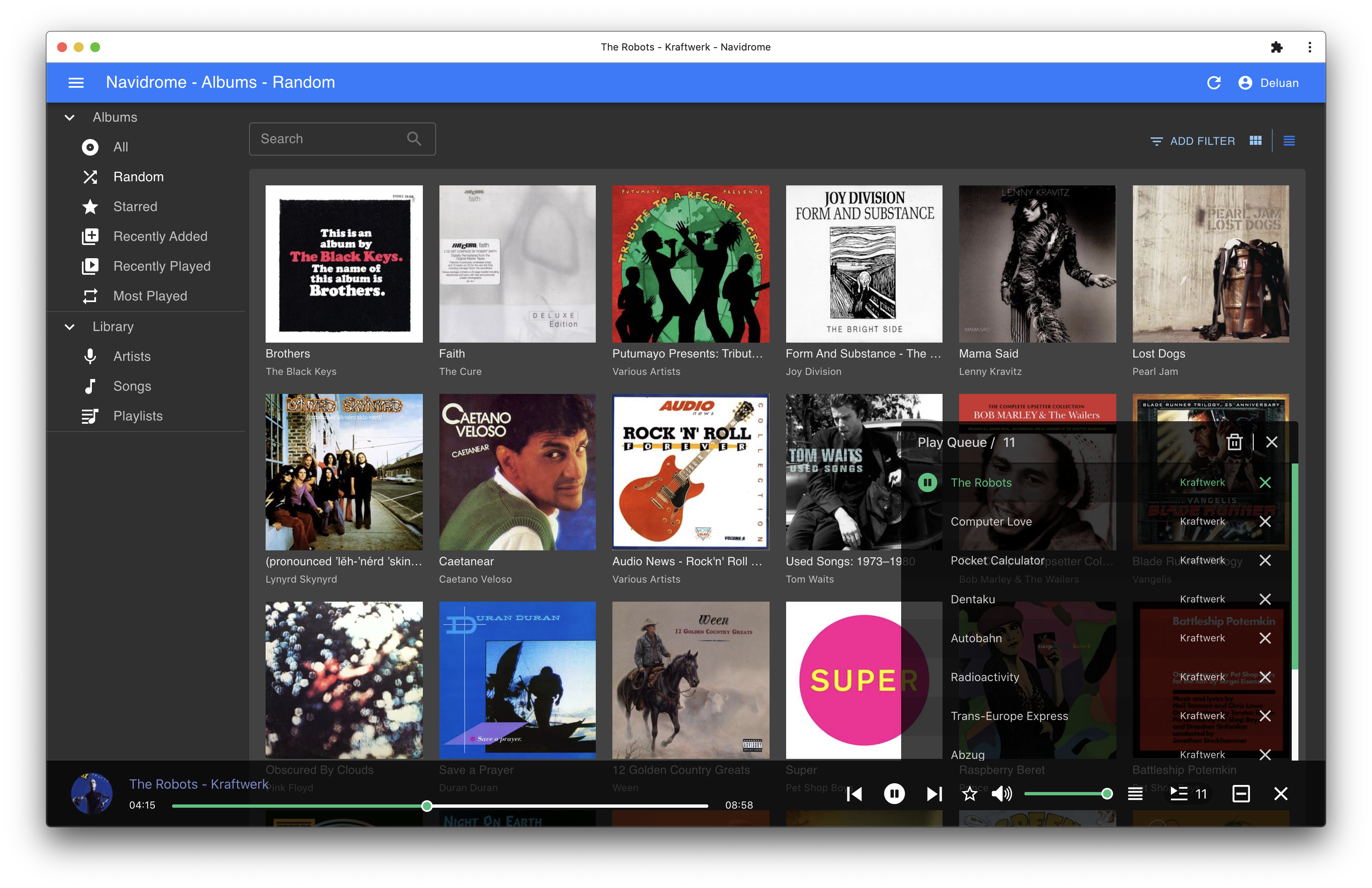
Navidrome is an open source web-based music collection server and streamer. It gives you freedom to listen to your music collection from any browser or mobile device. It's like your personal Spotify!
Note: The master branch may be in an unstable or even broken state during development.
Please use releases instead of
the master branch in order to get a stable set of binaries.
Check out our Live Demo!
Any feedback is welcome! If you need/want a new feature, find a bug or think of any way to improve Navidrome, please file a GitHub issue or join the discussion in our Subreddit. If you want to contribute to the project in any other way (ui/backend dev, translations, themes), please join the chat in our Discord server.
Installation
See instructions on the project's website
Cloud Hosting
PikaPods has partnered with us to offer you an officially supported, cloud-hosted solution. A share of the revenue helps fund the development of Navidrome at no additional cost for you.

Features
- Handles very large music collections
- Streams virtually any audio format available
- Reads and uses all your beautifully curated metadata
- Great support for compilations (Various Artists albums) and box sets (multi-disc albums)
- Multi-user, each user has their own play counts, playlists, favourites, etc...
- Very low resource usage
- Multi-platform, runs on macOS, Linux and Windows. Docker images are also provided
- Ready to use binaries for all major platforms, including Raspberry Pi
- Automatically monitors your library for changes, importing new files and reloading new metadata
- Supports lyrics from sidecar .ttml, .yaml/.yml Lyricsfile, .elrc, .lrc, .srt, .txt files and embedded TTML, Enhanced LRC, LRC, SRT, and plain-text tags (via
lyricspriority) - Themeable, modern and responsive Web interface based on Material UI
- Compatible with all Subsonic/Madsonic/Airsonic clients
- Transcoding on the fly. Can be set per user/player. Opus encoding is supported
- Translated to various languages
Translations
Navidrome uses POEditor for translations, and we are always looking for more contributors
Documentation
All documentation can be found in the project's website: https://www.navidrome.org/docs. Here are some useful direct links:
Screenshots