5ec6e6a8d4
* fix(subsonic): make search3 empty-query pagination fast at large offsets

Empty-query search3 (used by clients like Symfonium to sync the whole
library) degraded linearly with songOffset: the offset optimization in
optimizePagination keeps the original query's LEFT JOINs (annotation,
bookmark, library) inside its rowid NOT IN subquery, making it as slow as
plain OFFSET (~5s per page at offset 900K on a 920K-track library).

Rewrite the empty-query branch of doSearch to use the same two-phase
approach as the FTS search: Phase 1 paginates rowids on the bare main
table, which SQLite satisfies with a covering index at any offset; Phase 2
hydrates only the page's rows with all JOINs. The Phase 2 hydration logic
is extracted into hydrateRowidPage, now shared with ftsSearch.execute.

Also replace the media_file_missing index with a composite covering index
on (missing, library_id), so Phase 1 stays covering for non-admin users,
whose queries include a library_id filter. The composite serves all
missing-only lookups via its prefix.

With a 920K-track / 85K-album test library, search3 empty-query responses
are now flat (~0.1s) at every offset, for both admin and non-admin users
(previously 3-5s at offsets above 600K).

* refactor(persistence): share search Phase 1 contract and dedup junction fan-out

Extract the Phase 1 query assembly that was duplicated between the FTS
search and the empty-query search into executeTwoPhase: both paths now
supply only their strategy-specific FROM/JOINs and ORDER BY, while the
shared contract (missing filter, library access, options.Filters, and
Max/Offset semantics) lives in one place.

Also fix a pagination integrity bug: the artist library filter joins the
library_artist junction table, so an artist present in multiple libraries
produced duplicate rowids in Phase 1, corrupting offset-based pagination
(short pages and repeated artists during full-library syncs). Phase 1 now
applies DISTINCT whenever a junction-based LibraryFilter is set. DISTINCT
is used instead of GROUP BY because bm25() cannot be evaluated in a
grouped query; plain-filter tables (media_file, album) skip the dedup so
their Phase 1 keeps the streaming covering-index plan. This also fixes the
same duplication in the pre-existing FTS search path.

* fix(persistence): pin artist search Phase 1 join order with CROSS JOIN

search3 always filters artists by library (library_artist.library_id IN
...), and with the junction JOIN in the search Phase 1 rowid query SQLite
chose to drive from library_artist, sorting every junction row with a temp
b-tree on each page — a flat ~200ms penalty per request at 405K artists,
even at offset 0 (the previous code avoided this by accident: its GROUP BY
artist.id pinned an artist-driven plan).

Use CROSS JOIN (SQLite's explicit join-order override) in a search-only
variant of the artist library filter, keeping artist as the outer table so
Phase 1 streams rowids in artist.id order from the primary key index and
LIMIT/OFFSET short-circuits. The DISTINCT dedup stays and costs nothing
under the streaming plan. Other artist queries keep the planner's freedom.

With 405K artists, empty-query artist search is now 0.07s at offset 0 and
0.25s at offset 399K end-to-end (was 0.31s/0.34s before this fix, and up
to 1.2s on master at deep offsets). Artist FTS text search is unaffected.

Navidrome Music Server 








Navidrome is an open source web-based music collection server and streamer. It gives you freedom to listen to your music collection from any browser or mobile device. It's like your personal Spotify!
Note: The master branch may be in an unstable or even broken state during development.
Please use releases instead of
the master branch in order to get a stable set of binaries.
Check out our Live Demo!
Any feedback is welcome! If you need/want a new feature, find a bug or think of any way to improve Navidrome, please file a GitHub issue or join the discussion in our Subreddit. If you want to contribute to the project in any other way (ui/backend dev, translations, themes), please join the chat in our Discord server.
Installation
See instructions on the project's website
Cloud Hosting
PikaPods has partnered with us to offer you an officially supported, cloud-hosted solution. A share of the revenue helps fund the development of Navidrome at no additional cost for you.

Features
- Handles very large music collections
- Streams virtually any audio format available
- Reads and uses all your beautifully curated metadata
- Great support for compilations (Various Artists albums) and box sets (multi-disc albums)
- Multi-user, each user has their own play counts, playlists, favourites, etc...
- Very low resource usage
- Multi-platform, runs on macOS, Linux and Windows. Docker images are also provided
- Ready to use binaries for all major platforms, including Raspberry Pi
- Automatically monitors your library for changes, importing new files and reloading new metadata
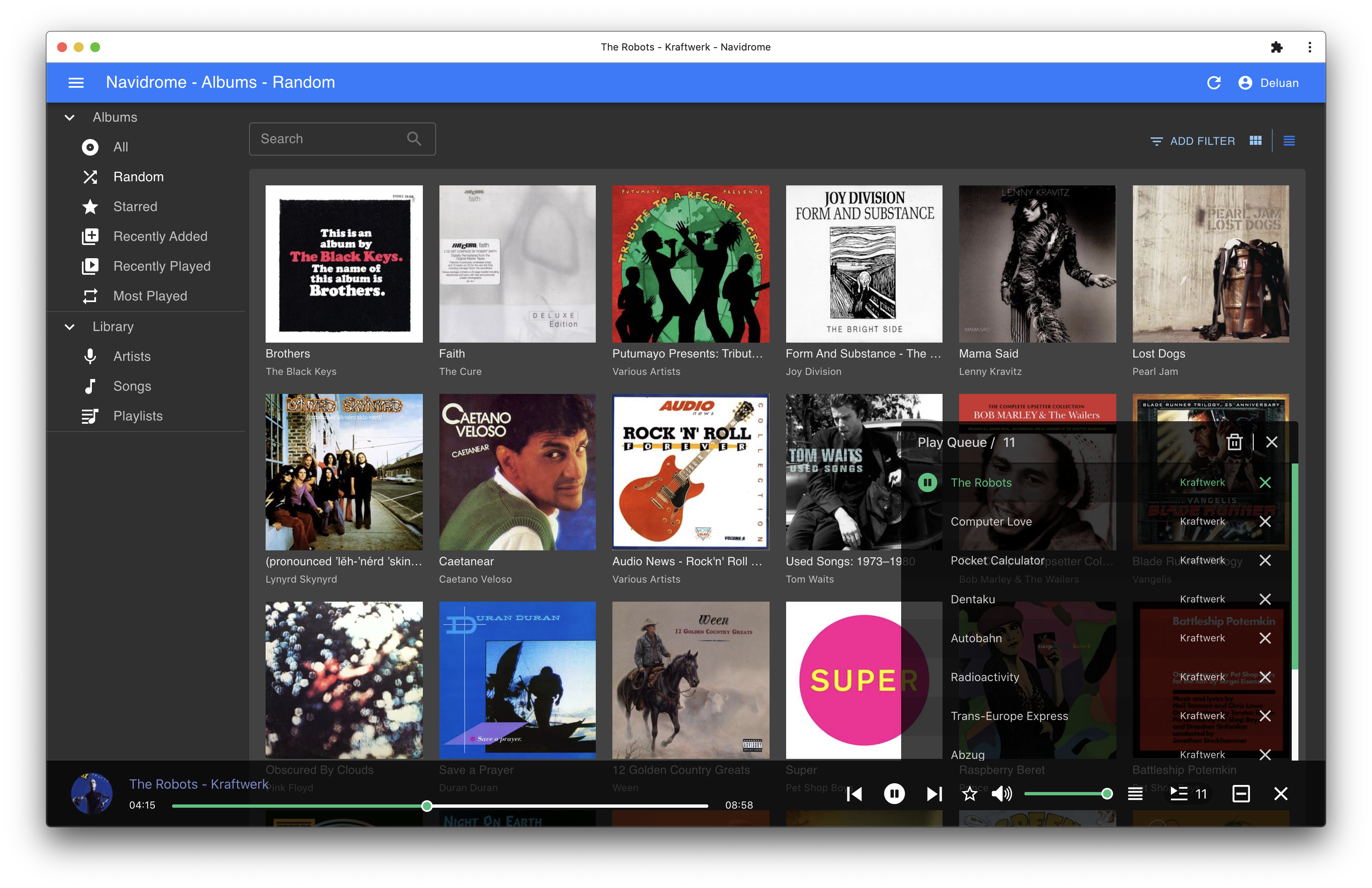
- Themeable, modern and responsive Web interface based on Material UI
- Compatible with all Subsonic/Madsonic/Airsonic clients
- Transcoding on the fly. Can be set per user/player. Opus encoding is supported
- Translated to various languages
Translations
Navidrome uses POEditor for translations, and we are always looking for more contributors
Documentation
All documentation can be found in the project's website: https://www.navidrome.org/docs. Here are some useful direct links:
Screenshots