63a5954e4f
* fix(smartplaylist): use annotation index for playcount/rating/loved filters

Annotation-field criteria wrapped the column in COALESCE(col, default) so
missing annotation rows behave as 0/false. COALESCE prevents SQLite from
using the column index, forcing a full media_file scan during smart playlist
materialization - multi-second loads on large libraries, independent of rule
complexity.

Store the raw column plus its default and drop COALESCE when the compared
value cannot match the default; fall back to 'col <op> ? OR col IS NULL' when
the default would match, so never-annotated tracks are still preserved.
Sorting keeps COALESCE to retain deterministic NULL ordering. Result set is
unchanged; the materialize query now seeks the annotation index.

Signed-off-by: Deluan <deluan@deluan.com>

* fix(smartplaylist): keep COALESCE for list-valued annotation comparisons

Hardening from final review: a list value (IN (...)) can't drive the index
and a default-inclusive list has per-element NULL semantics, so route slice
values through COALESCE(col, default) to stay exactly equivalent to the prior
form. Also make the bool-default branch explicit (loved only supports
equality operators) and share the COALESCE rendering via coalesceExpr.

Signed-off-by: Deluan <deluan@deluan.com>

* refactor(smartplaylist): make coalesced() a field method

Thermo-nuclear review follow-up: promote the free coalesceExpr(f) to a
smartPlaylistField.coalesced() method that returns the bare expression when
there is no default. This lets sortExpr call field.coalesced() unconditionally
and drop its 'if coalesceDefault != nil' branch, removing the 'only annotation
fields get coalesced' special case from the sort path. Behavior unchanged.

Signed-off-by: Deluan <deluan@deluan.com>

* fix(smartplaylist): keep COALESCE for LIKE, bool-ordering, and tag ranges

Code review (xhigh) found the index-friendly rewrite did not cover every
operator, breaking result-set equivalence on a few reachable raw-JSON paths:

- LIKE family (contains/startsWith/endsWith/notContains) on annotation fields
  used the bare column, so a NULL column never matched and missing-annotation
  rows were dropped.
- Ordering comparators (gt/lt/...) on bool fields (loved) were decided as
  equality, wrongly including never-annotated rows.
- InTheRange on a numeric tag split into two independent json_tree EXISTS,
  letting different tag values satisfy each bound.

Centralize the decision in annotationCond via bareNullInclusion: emit the
index-friendly bare form only for scalar values under an exactly-orderable
comparator, otherwise fall back to the COALESCE form (always equivalent to the
original). Route LIKE through coalesced(); reject tag/role ranges. Replace the
local toFloat/toBool with spf13/cast (fixes unhandled numeric types and string
bool forms), and drop the redundant LookupField + double reflect.TypeOf.

A 17-case brute-force check confirms row-set equivalence to the prior
COALESCE form across all operators including the fixed LIKE/bool cases.

Signed-off-by: Deluan <deluan@deluan.com>

* fix(smartplaylist): keep COALESCE for list values on bool annotation fields

Second review found the bareNullInclusion bool branch missed the non-scalar
guard the numeric branch has: a list value on loved/albumloved/artistloved
(e.g. {"is":{"loved":[true]}}) coerced through toBool (which swallowed the
cast error) to false, emitting the bare/OR-IS-NULL form and wrongly including
never-annotated rows. Make toBool return (value, ok) like toFloat and bail to
COALESCE when the value isn't a scalar bool. Also add the missing test for the
tag/role range rejection. A 21-case brute-force confirms row-set equivalence to
the original COALESCE form across every operator, including the bool/numeric
list paths.

Signed-off-by: Deluan <deluan@deluan.com>

* refactor(smartplaylist): drop spf13/cast for stdlib value coercion

The value coercion only sees the handful of types criteria produces (int,
float64, string from JSON; bool already normalized at unmarshal), so cast's
broad conversion isn't needed. Use small explicit type switches over strconv
instead, keeping the string fallback (ParseFloat/ParseBool) that closes the
'1'/'t' gap. No dependency change — cast returns to indirect.

Signed-off-by: Deluan <deluan@deluan.com>

* refactor(smartplaylist): share bool coercion via criteria.ToBool

normalizeBoolValue (unmarshal-time) and the persistence bool guard both parsed
bool-ish values independently. Extract the shared logic into an exported
criteria.ToBool(any) (bool, ok): normalizeBoolValue delegates to it (behavior
unchanged), and the persistence layer reuses it via its existing model/criteria
import instead of a local helper. No behavior change.

Signed-off-by: Deluan <deluan@deluan.com>

* refactor(smartplaylist): trim sqlLiteral and dedup rationale comments

/simplify cleanup: fmt %v already renders bool defaults as false/true, so drop
sqlLiteral's redundant bool branch. Consolidate the COALESCE-vs-index rationale
to the smartPlaylistField comment instead of repeating it across annotationCond
and the struct. No behavior change.

Signed-off-by: Deluan <deluan@deluan.com>

* fix(smartplaylist): address review feedback on multi-field maps and *any

From the PR bot reviews:
- sqlFields now uses the field's coalesced() form, so annotation fields in a
  multi-field operator map (Is/Gt/Contains with >1 key) keep COALESCE and don't
  silently drop never-annotated rows. Covers both the comparison and LIKE
  fallback paths. (Gemini high, Copilot)
- Replace coalesceDefault *any with a plain any (0/false are non-nil
  interfaces, so nil still means 'no default'); drop the coalesce() boxing
  helper and the pointer indirection. (Gemini)
- Give rangeExpr clear, range-specific errors for the multi-field and malformed
  -pair cases instead of an empty-field / 'in operator' message. (Copilot)

Adds tests for the multi-field COALESCE behavior and the new range errors.

Signed-off-by: Deluan <deluan@deluan.com>

* Revert multi-field COALESCE handling (YAGNI)

The multi-field operator map case the bots flagged is unreachable: marshalExpression
rejects any operator map with more than one field, so a multi-field map can never be
persisted or loaded. Revert the sqlFields change and its tests rather than harden a
code path no supported input can reach. Keep the two reachable improvements from the
review: coalesceDefault any (not *any), and the clearer malformed-range error.

Signed-off-by: Deluan <deluan@deluan.com>

* refactor(persistence): model comparator as a behavior-carrying struct

The smart-playlist comparator was a bare string alias, forcing two parallel
switches over the same six operators: squirrelCmp mapped each to its squirrel
constructor, and bareNullInclusion restated each as a float predicate. Adding
or changing an operator meant editing both in sync.

Make comparator a struct that bundles those facts per operator (the squirrel
builder, the operator as a float predicate, and whether it's an ordering op).
Both switches collapse: squirrelCmp is deleted in favor of cmp.build, and
bareNullInclusion's numeric switch becomes a single cmp.satisfy call. Generated
SQL is unchanged, as the existing table-driven tests confirm.

* docs(smartplaylist): trim comments that restate the code

Remove or tighten comments that describe what the code already says (likeCond and
comparisonExpr doc lines, redundant clauses in annotationField/coalesced/ToBool/
normalizeBoolValue). Keep the comments that explain non-obvious rationale: the
COALESCE-vs-index tradeoff, the bareNullInclusion/annotationCond contracts, and the
why-we-fall-back notes.

* docs(smartplaylist): collapse coalesceDefault comment to one line

The field's six-line block duplicated the COALESCE-vs-index rationale that already
lives on annotationCond. Reduce it to a one-line description plus a pointer there.

---------

Signed-off-by: Deluan <deluan@deluan.com>

Navidrome Music Server 








Navidrome is an open source web-based music collection server and streamer. It gives you freedom to listen to your music collection from any browser or mobile device. It's like your personal Spotify!
Note: The master branch may be in an unstable or even broken state during development.
Please use releases instead of
the master branch in order to get a stable set of binaries.
Check out our Live Demo!
Any feedback is welcome! If you need/want a new feature, find a bug or think of any way to improve Navidrome, please file a GitHub issue or join the discussion in our Subreddit. If you want to contribute to the project in any other way (ui/backend dev, translations, themes), please join the chat in our Discord server.
Installation
See instructions on the project's website
Cloud Hosting
PikaPods has partnered with us to offer you an officially supported, cloud-hosted solution. A share of the revenue helps fund the development of Navidrome at no additional cost for you.

Features
- Handles very large music collections
- Streams virtually any audio format available
- Reads and uses all your beautifully curated metadata
- Great support for compilations (Various Artists albums) and box sets (multi-disc albums)
- Multi-user, each user has their own play counts, playlists, favourites, etc...
- Very low resource usage
- Multi-platform, runs on macOS, Linux and Windows. Docker images are also provided
- Ready to use binaries for all major platforms, including Raspberry Pi
- Automatically monitors your library for changes, importing new files and reloading new metadata
- Supports lyrics from sidecar .ttml, .yaml/.yml Lyricsfile, .elrc, .lrc, .srt, .txt files and embedded TTML, Enhanced LRC, LRC, SRT, and plain-text tags (via
lyricspriority) - Themeable, modern and responsive Web interface based on Material UI
- Compatible with all Subsonic/Madsonic/Airsonic clients
- Transcoding on the fly. Can be set per user/player. Opus encoding is supported
- Translated to various languages
Translations
Navidrome uses POEditor for translations, and we are always looking for more contributors
Documentation
All documentation can be found in the project's website: https://www.navidrome.org/docs. Here are some useful direct links:
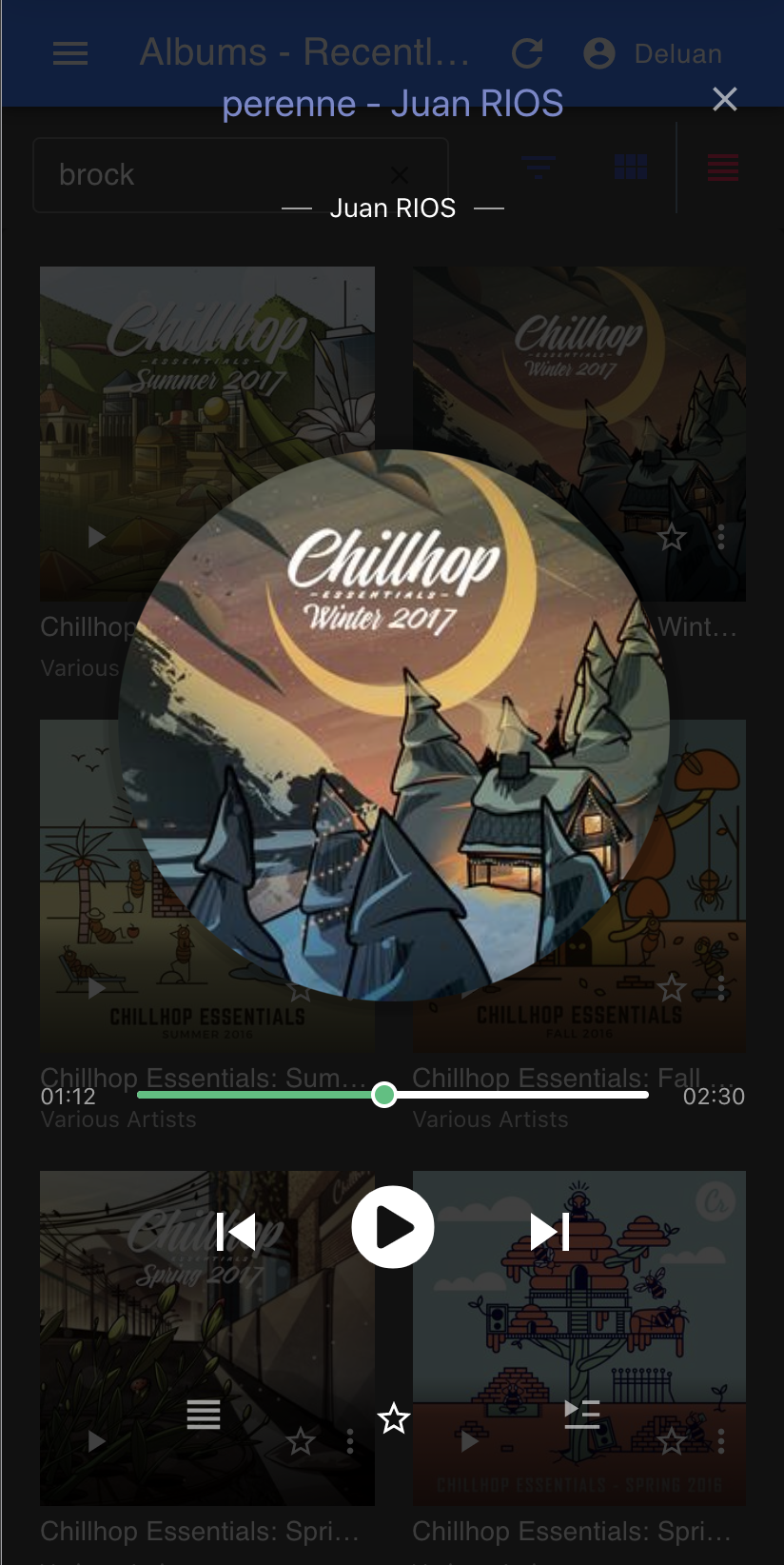
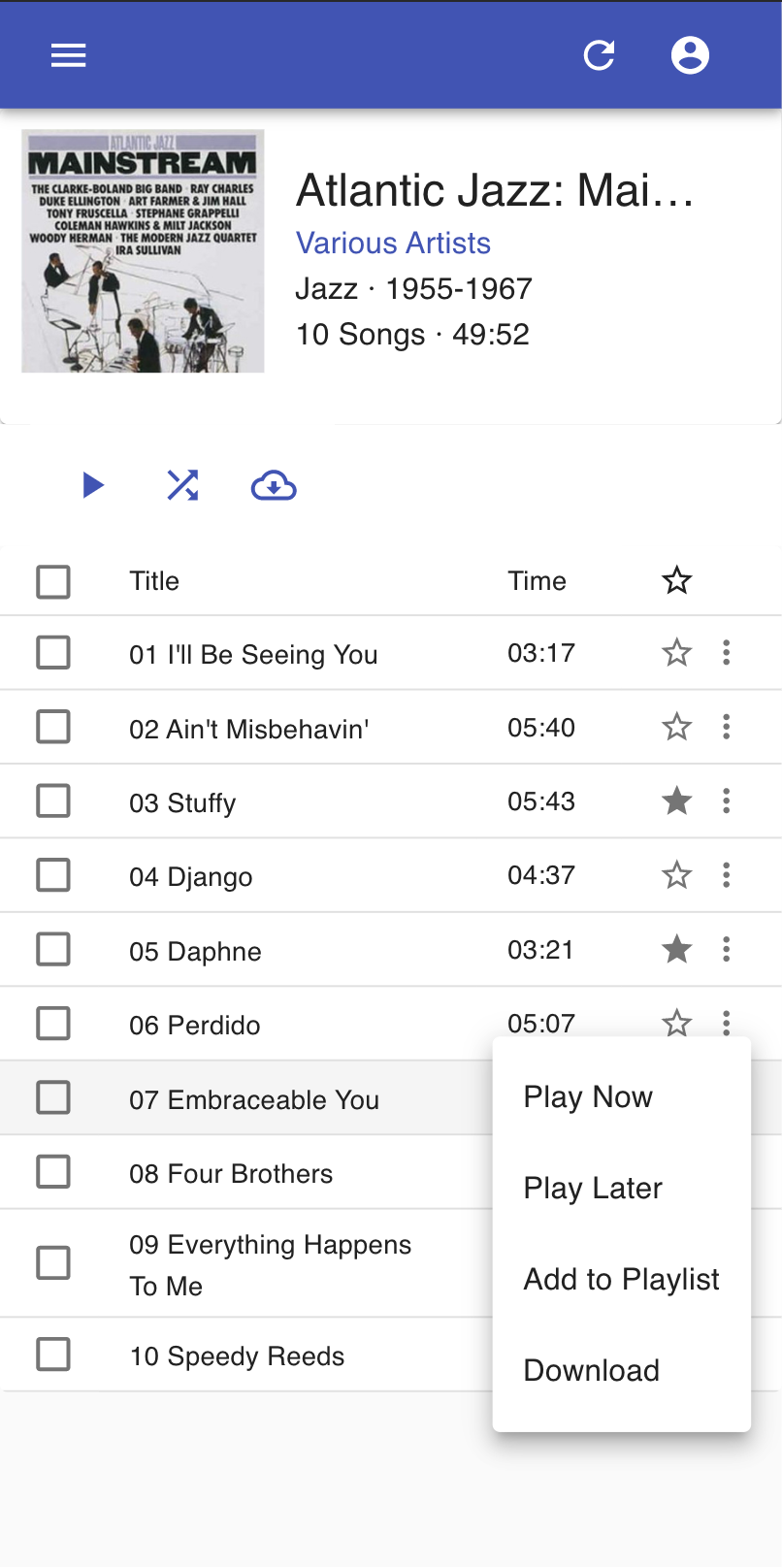
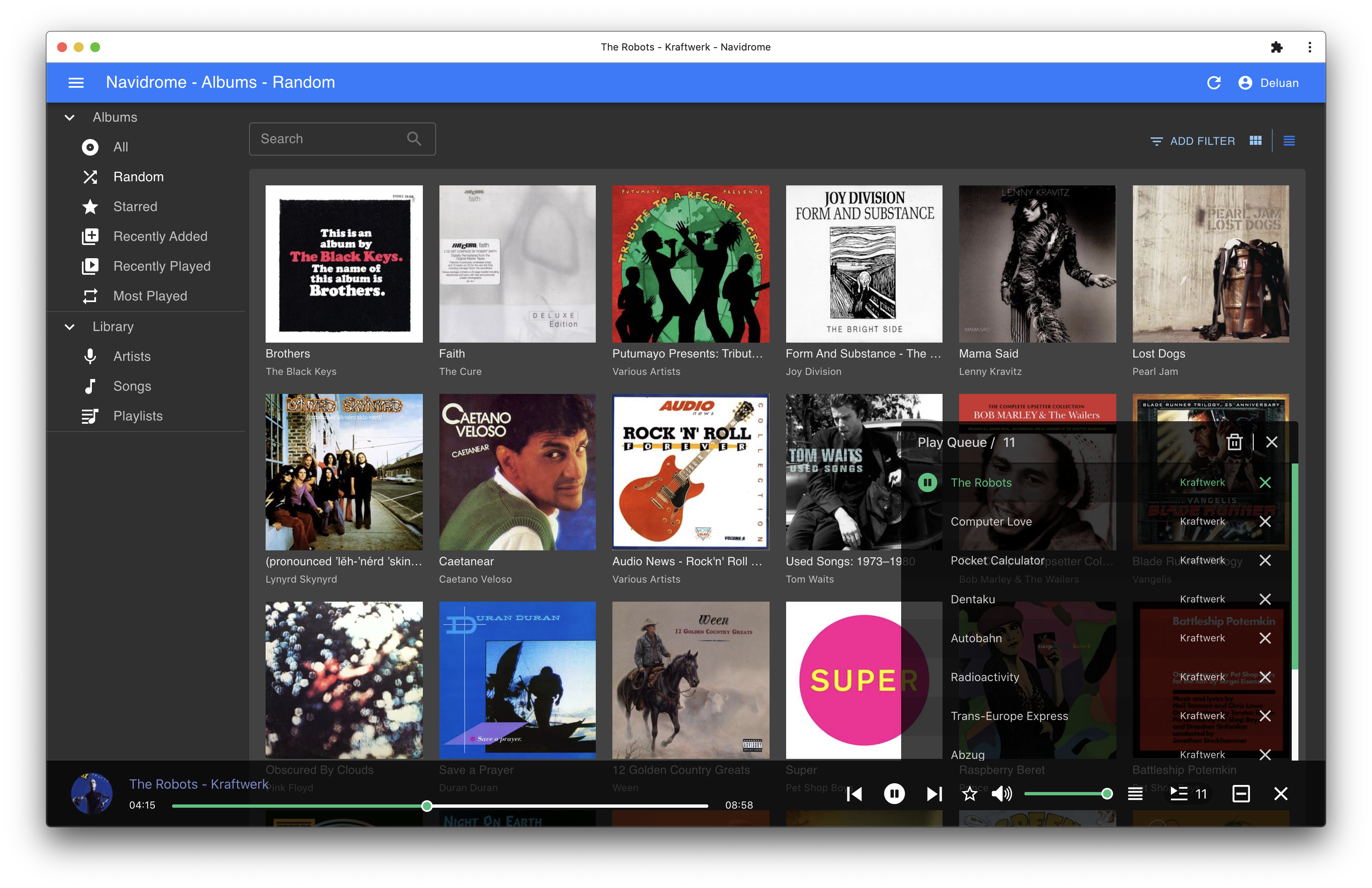
Screenshots