803b385920
* refactor(matcher): carry resolved artist MBID on sanitizedTrack

* feat(matcher): two-phase artist resolution for title matching

* fix(matcher): wire phase-1 artist mock in consumer tests; guard back-map dupes

- External tests for title-fallback paths now register a second `.Maybe()`
  artistRepo.GetAll expectation for the matcher's phase-1 artist-resolution
  call, and supply RoleArtist Participants on phase-2 track mocks so the
  back-map routes tracks to their query buckets correctly.
- Back-map loop extracted into buildTracksByQuery helper; guard ensures each
  track is appended at most once per query bucket even when it credits multiple
  resolved artists in that bucket, preventing duplicate scoring.
- matchTitlePhase2 helper: removed redundant squirrel.Sqlizer type assertion
  (ranging over squirrel.And already yields Sqlizer).

* perf(matcher): use non-correlated IN subquery for phase-2 lookup

* refactor(matcher): decompose two-phase title matching into named steps

matchByTitle had grown to ~98 lines holding four jobs and eleven locals. Split
it into a thin orchestrator over named phases:

- groupQueriesByArtist: build the per-artist query buckets.
- resolveArtists / resolvedArtists: phase 1, with the three parallel maps
  (byQuery / mbid / allIDs) folded into one type that owns artist-ID routing and
  track bucketing. Artist ownership is now two direct map lookups (by order name,
  by MBID) instead of the prior O(artists x queries) nested scan.
- fetchTracksCreditedTo: phase 2, using squirrel.Placeholders instead of a
  hand-rolled placeholder string.
- bucketTracks / scoring loop: unchanged behavior.

Pure restructuring; the suite, race, consumers, and the real-DB benchmark are all
unchanged. Also dedupes the phase-1 MBID filter as a side effect.

* refactor(matcher): apply simplify cleanups to two-phase resolution

Behavior-preserving cleanups from a /simplify pass:
- struct{} sets instead of bool-valued sets (codebase convention)
- move newSanitizedTrack after the dedup guard in bucketTracks, so a track
  credited to multiple resolved artists is sanitized only when actually bucketed
- pre-size the phase-1/phase-2 maps; drop the dead nil-guard in own()
- slice.Map for the []string->[]any arg conversion
- document why the raw media_file_artists SQL stays in this layer, and that
  bucketTracks relies on the bulk participants JSON carrying artist IDs
- extract an artistParticipants() test helper, collapsing 57 four-level
  Participants literals (test file -211 lines net)

* docs(matcher): rename inner title-matching steps to avoid 'phase' clash

The matcher's top-level strategies (ID/MBID/ISRC/Title) are already called phases.
Reusing 'phase 1/2' for the two steps inside title matching (resolve artists,
fetch their tracks) was confusing. Drop the ordinals and let the function names
(resolveArtists, fetchTracksCreditedTo) and prose describe the steps. Renamed the
matchTitlePhase2 test helper to matchTracksByArtistQuery. Comment-only; no behavior
change.

* fix(matcher): own MBID-resolved artists for every aliased query

Address bot review on PR #5637. When several agent queries share one
ArtistMBID under different sanitized names (agent aliases), the resolver
kept only the last query name per MBID, so the others never owned the
resolved artist and their songs fell through. Track all query names per
MBID instead; add a RED-proven test for the two-alias case.

Also invert byQuery into a reverse artist-ID -> query-name index in
bucketTracks, dropping the per-participant scan over all queries, and
guard fetchTracksCreditedTo against an empty artist-ID slice. Fix the
artist mock to forward variadic options with Called(options...) so
QueryOptions-shaped matchers receive the same argument shape as real
calls.

* docs(matcher): trim comments that restated the code

Cut three doc comments down to their why: groupQueriesByArtist, own, and
bucketTracks no longer restate what the signature and body already show.
Condense fetchTracksCreditedTo's rationale from two paragraphs to one,
keeping the role='artist', non-correlated-IN, and layer-boundary notes.

Navidrome Music Server 








Navidrome is an open source web-based music collection server and streamer. It gives you freedom to listen to your music collection from any browser or mobile device. It's like your personal Spotify!
Note: The master branch may be in an unstable or even broken state during development.
Please use releases instead of
the master branch in order to get a stable set of binaries.
Check out our Live Demo!
Any feedback is welcome! If you need/want a new feature, find a bug or think of any way to improve Navidrome, please file a GitHub issue or join the discussion in our Subreddit. If you want to contribute to the project in any other way (ui/backend dev, translations, themes), please join the chat in our Discord server.
Installation
See instructions on the project's website
Cloud Hosting
PikaPods has partnered with us to offer you an officially supported, cloud-hosted solution. A share of the revenue helps fund the development of Navidrome at no additional cost for you.

Features
- Handles very large music collections
- Streams virtually any audio format available
- Reads and uses all your beautifully curated metadata
- Great support for compilations (Various Artists albums) and box sets (multi-disc albums)
- Multi-user, each user has their own play counts, playlists, favourites, etc...
- Very low resource usage
- Multi-platform, runs on macOS, Linux and Windows. Docker images are also provided
- Ready to use binaries for all major platforms, including Raspberry Pi
- Automatically monitors your library for changes, importing new files and reloading new metadata
- Supports lyrics from sidecar .ttml, .yaml/.yml Lyricsfile, .elrc, .lrc, .srt, .txt files and embedded TTML, Enhanced LRC, LRC, SRT, and plain-text tags (via
lyricspriority) - Themeable, modern and responsive Web interface based on Material UI
- Compatible with all Subsonic/Madsonic/Airsonic clients
- Transcoding on the fly. Can be set per user/player. Opus encoding is supported
- Translated to various languages
Translations
Navidrome uses POEditor for translations, and we are always looking for more contributors
Documentation
All documentation can be found in the project's website: https://www.navidrome.org/docs. Here are some useful direct links:
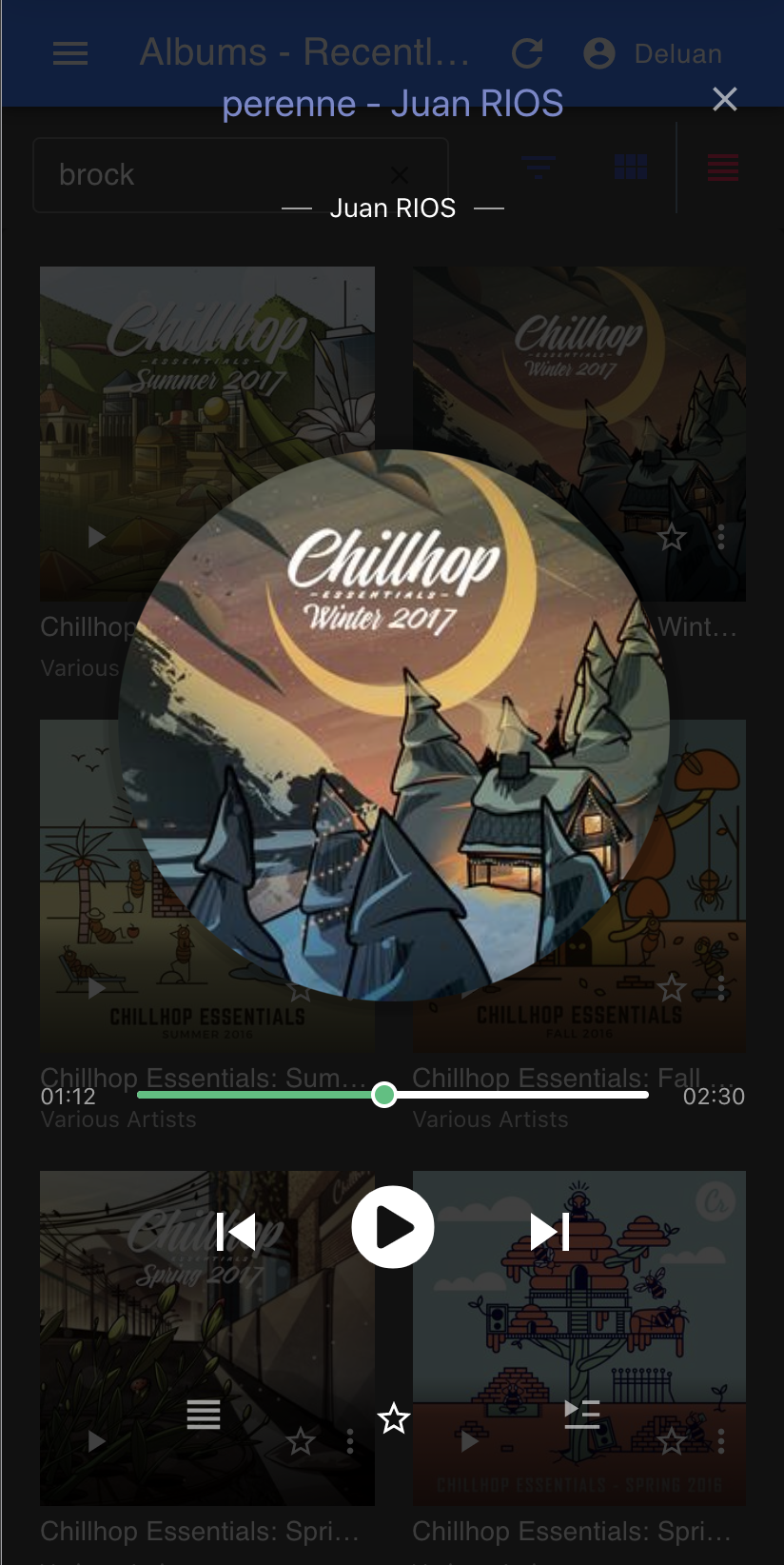
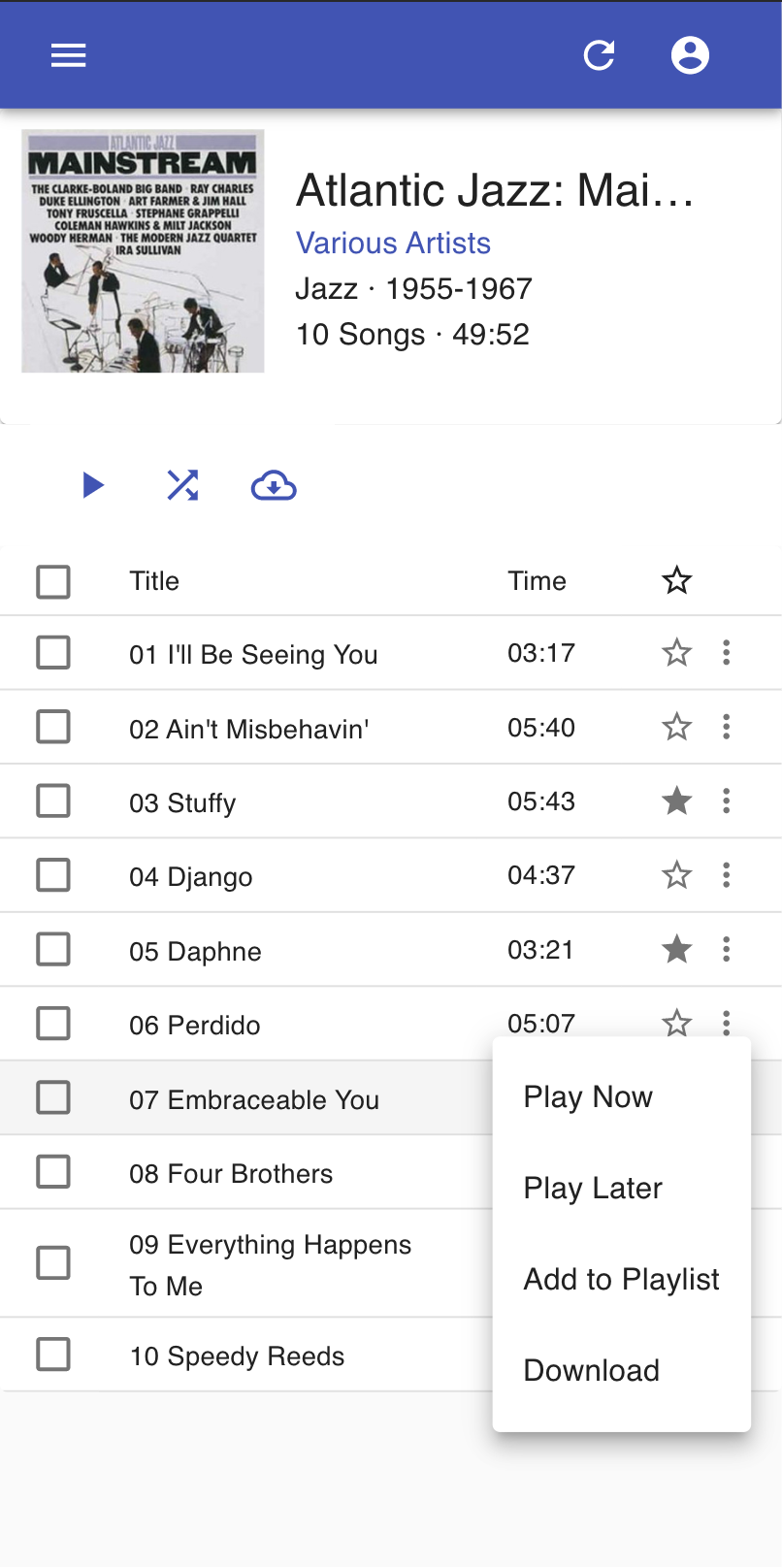
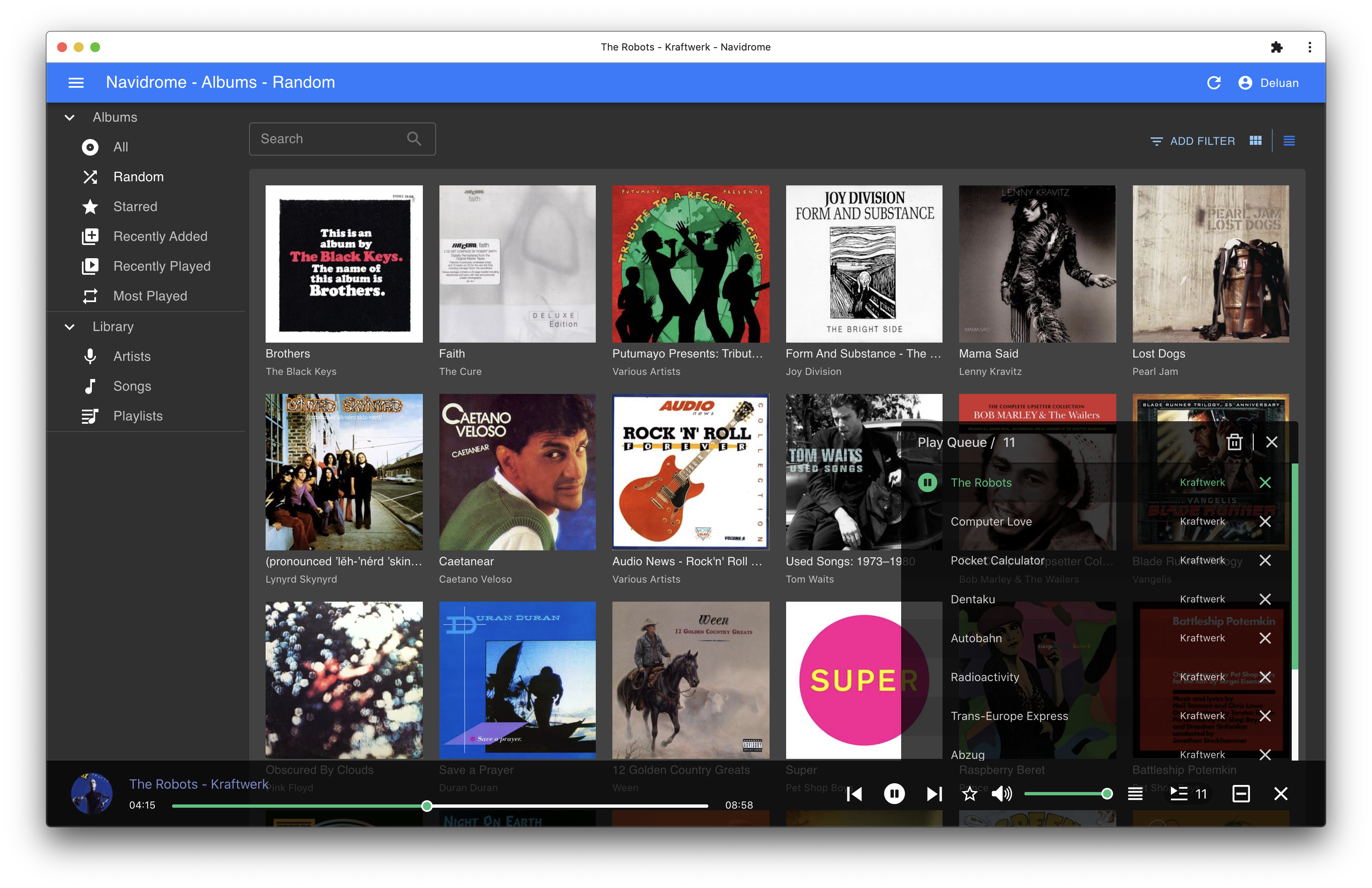
Screenshots