adeaa93e7e
* fix(jellyfin): honor Recursive=false for library parents

/Items ignored the Recursive parameter entirely — it appeared only in tests,
never in production code. Finamp's download sync sends exactly one
Recursive=false request per library (ParentId=<library>&IncludeItemTypes=Audio)
to pick up tracks outside any album, supplementing its recursive per-album
fetch. We answered with every song in the library: 208MB and 21s per sync
measured on a real library, against 20KB for the album queries. Finamp then
required every track twice, once via its album and once under the library node.

In Jellyfin 10.10 Recursive never reaches SQL. It selects between an in-memory
walk of a folder's direct Children (false) and a DB ancestor query (true), with
IncludeItemTypes applied as a post-filter over that direct-child list
(ItemsController.cs:308, Folder.cs:949-994). The default is false, and neither
IncludeItemTypes nor SearchTerm forces recursion, so Recursive=false with
IncludeItemTypes=Audio on a music library returns an empty list — which is what
Finamp expects and codes for.

Filter the requested types to those nested directly under a library when the
parent is a library and Recursive is not true; the hierarchy this API exposes is
library -> album -> track, so no track is ever a library's direct child. Album
and playlist parents are untouched, as their tracks are real direct children in
Jellyfin (MusicAlbum.cs:86-89, Playlist.cs:140-167) and Jellify opens playlists
with Recursive=false. A library parent is the only case handled: /Items with no
ParentId still returns every song where Jellyfin returns the root's children,
but no observed client sends that, and honoring it would surprise any client
that simply omits Recursive.

* refactor(jellyfin): narrow the Recursive=false filter to Audio

Replace the libraryChildTypes allowlist with a direct Audio check. The two are
behaviorally identical — parseTypes only ever yields Audio, MusicArtist,
MusicAlbum, MusicGenre or Playlist, and the allowlist held the latter four, so
it excluded exactly Audio and nothing else.

The allowlist claimed those four are a library's direct children. That isn't
true of MusicGenre or Playlist: listGenres is deliberately unscoped because
genres are global tags, and listPlaylists ignores scopeIDs entirely, so neither
is nested under a library at all. They were on the list only to leave their
behavior untouched. The one verified invariant is that no track is a library's
direct child, so state just that — it is also more conservative, as a type added
later keeps its current behavior instead of being filtered by a stale list.

Add a test pinning the omitted-Recursive default: ItemsController binds
`bool? recursive` and reads it as `recursive ?? false`, so omitting the param is
a non-recursive request and filters Audio for a library parent.

Navidrome Music Server 








Navidrome is an open source web-based music collection server and streamer. It gives you freedom to listen to your music collection from any browser or mobile device. It's like your personal Spotify!
Note: The master branch may be in an unstable or even broken state during development.
Please use releases instead of
the master branch in order to get a stable set of binaries.
Check out our Live Demo!
Any feedback is welcome! If you need/want a new feature, find a bug or think of any way to improve Navidrome, please file a GitHub issue or join the discussion in our Subreddit. If you want to contribute to the project in any other way (ui/backend dev, translations, themes), please join the chat in our Discord server.
Installation
See instructions on the project's website
Cloud Hosting
PikaPods has partnered with us to offer you an officially supported, cloud-hosted solution. A share of the revenue helps fund the development of Navidrome at no additional cost for you.

Features
- Handles very large music collections
- Streams virtually any audio format available
- Reads and uses all your beautifully curated metadata
- Great support for compilations (Various Artists albums) and box sets (multi-disc albums)
- Multi-user, each user has their own play counts, playlists, favourites, etc...
- Very low resource usage
- Multi-platform, runs on macOS, Linux and Windows. Docker images are also provided
- Ready to use binaries for all major platforms, including Raspberry Pi
- Automatically monitors your library for changes, importing new files and reloading new metadata
- Supports lyrics from sidecar .ttml, .yaml/.yml Lyricsfile, .elrc, .lrc, .srt, .txt files and embedded TTML, Enhanced LRC, LRC, SRT, and plain-text tags (via
lyricspriority) - Themeable, modern and responsive Web interface based on Material UI
- Compatible with all Subsonic/Madsonic/Airsonic clients
- Transcoding on the fly. Can be set per user/player. Opus encoding is supported
- Translated to various languages
Translations
Navidrome uses POEditor for translations, and we are always looking for more contributors
Documentation
All documentation can be found in the project's website: https://www.navidrome.org/docs. Here are some useful direct links:
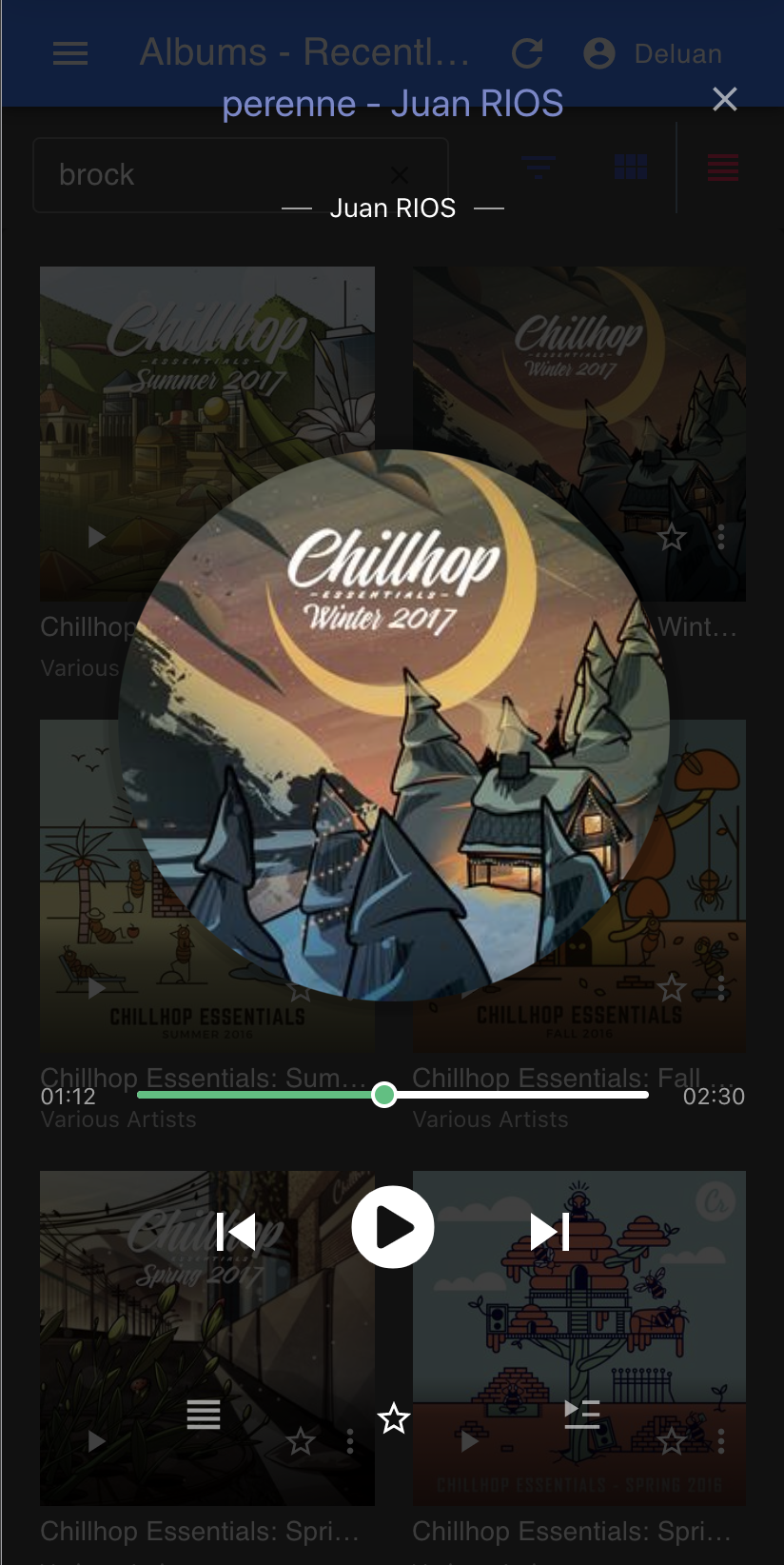
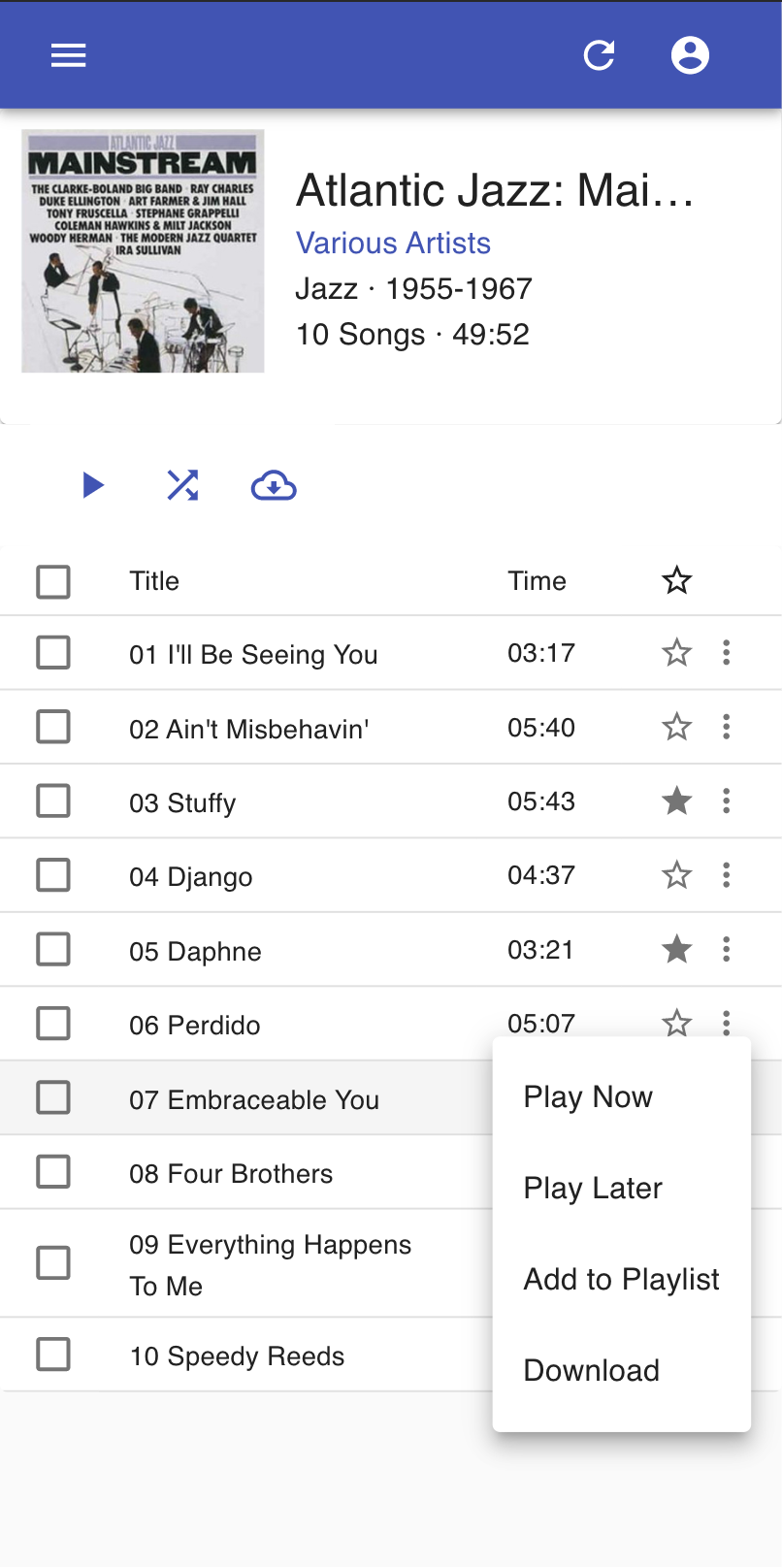
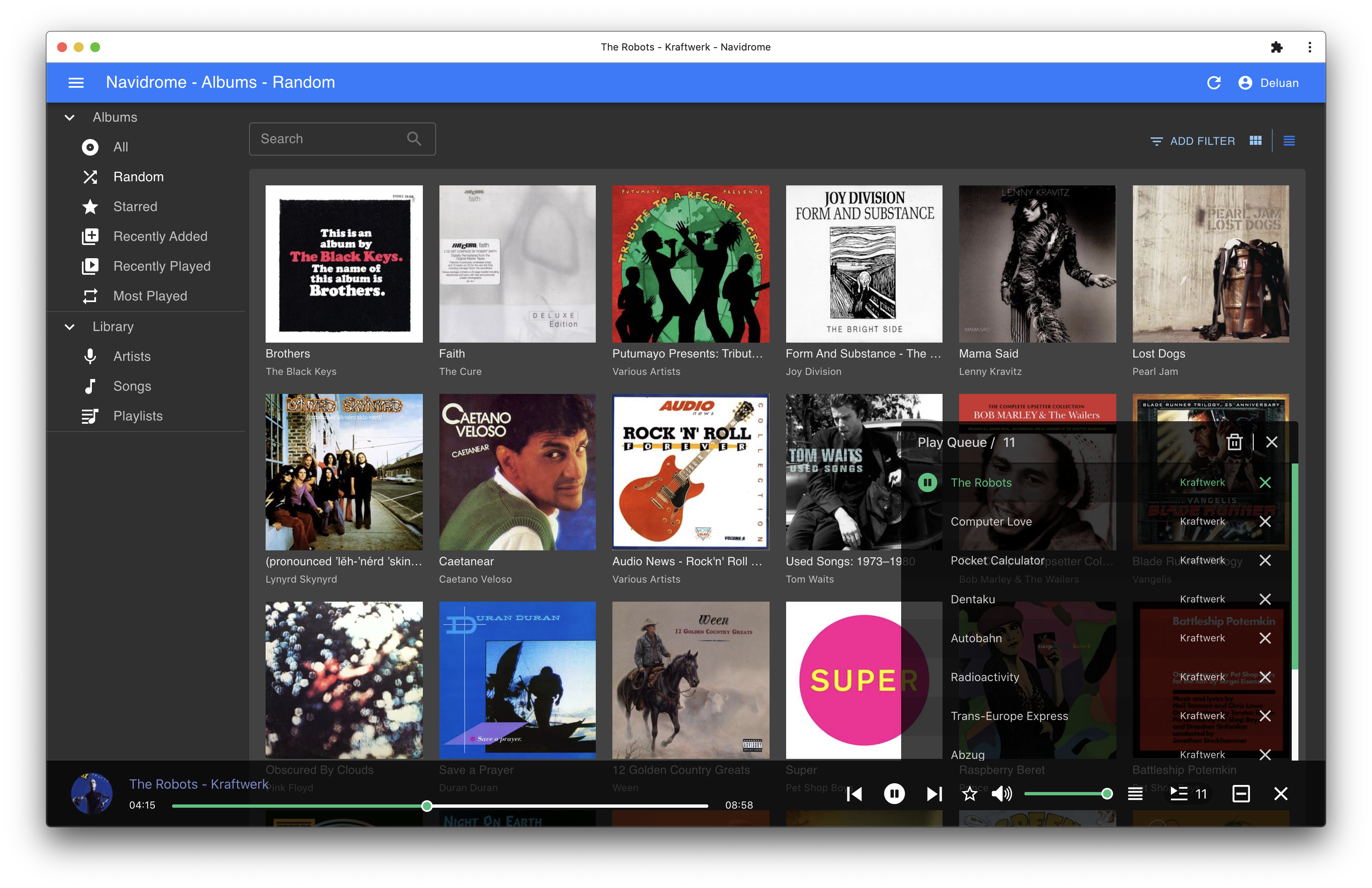
Screenshots