c66ef04dd3
* test(jellyfin): use canonical ids in dto fixtures

Fixtures used short placeholder strings, which are not valid Navidrome ids. Deriving them from
id.NewHash keeps the labels readable while exercising the real id shape.

* test(jellyfin): use canonical ids in handler fixtures

Fixtures used short placeholder strings, which are not valid Navidrome ids. Deriving them from
id.NewHash keeps the labels readable while exercising the real id shape. Playlist entry positions
stay decimal, matching the integer playlist_tracks.id column.

* test(jellyfin): use canonical ids in e2e fixtures

Fixtures used short placeholder strings, which are not valid Navidrome ids. Deriving them from
id.NewHash keeps the labels readable while exercising the real id shape.

* test(jellyfin): use canonical ids in audiomuse fixtures

audiomuse_test.go passes ids as bare function args (mf(id, ...), call(query, user)) rather than
via ID: struct-literal fields, so the original grep-built file list missed it. Same conversion as
the rest of the fixtures: fake labels through id.NewHash via testID.

* test(jellyfin): convert remaining nonexistent-id sentinels in e2e tests

Reviewer swept for enc("literal") sites the brief's dto.EncodeID grep missed. These "does not
exist" fixtures must stay well-formed GUIDs under the strict codec, or the test degrades from
"resolves to nothing" to "empty path segment".

* refactor(jellyfin): emit real 128-bit GUIDs as item ids

Navidrome ids are now a canonical 22-char base62 encoding of exactly 128 bits, so they map
losslessly onto Jellyfin GUIDs. Previously the API hex-encoded the id string itself, producing
44 hex chars where Jellyfin uses 32.

Integer library ids, the synthetic playlists folder, and playlist entry positions (a
playlist_tracks.id, an integer column) aren't 128-bit values, so they get a reserved GUID space
tagged by kind. DecodeID is now strict: malformed input returns an empty string instead of
passing through unchanged.

BREAKING: Jellyfin clients see entirely new item ids.

* fix(jellyfin): 404 malformed playlist ids instead of silently creating

updatePlaylist decoded a malformed playlistId to "", the same sentinel core/playlists.Create
uses to mean "make a new playlist" — the overload createPlaylist deliberately relies on. A
malformed id now 404s before reaching Create.

Also tightens id-codec test fixtures: several tests set chi params to a raw canonical id, which
now decodes to "" and only passed because the fakes ignore the id argument; and a batch of
not-found sentinels now use well-formed-but-nonexistent GUIDs so they exercise the intended path
instead of the malformed-id path. READMEs "lossless" claim softened to note the reserved space.

* refactor(jellyfin): drop the id truncation workaround

Finamp's saved-queue packing keeps the first 16 bytes of each item id. That was lossy only
because our ids were 44 hex chars; now they are 32, so the packing round-trips exactly and the
server-side prefix recovery is dead code.

Removes an indexed range scan per restored queue and the ambiguous-prefix path that could
resolve to the wrong item.

* fix(jellyfin): emit ServerId and PlaySessionId in Jellyfin's id format

Jellyfin serializes GUIDs without dashes; ServerId was emitting the dashed UUID form. A
ServerId persisted before this change is normalized on read rather than rewritten.

PlaySessionId was emitting a raw internal id instead of the encoded form.

BREAKING: the ServerId change makes clients treat the server as new, so users re-login once.

* fix(jellyfin): 404 on undecodable id filters instead of widening the query

DecodeID collapsed an absent param and an undecodable one into the empty string, and downstream
an empty id means no filter. A client sending a stale pre-upgrade id therefore had its filter
silently dropped: ParentId, ArtistIds and AlbumArtistIds each returned the whole library instead
of a scoped result. Every existing client hits this on first launch after the id format changes.

Scalar id params now distinguish the two cases and report not-found. List-valued params already
failed closed. EncodeID logs a diagnostic when a non-empty id is not canonical, which should not
happen post-migration and would otherwise ship an unaddressable item silently.

* test(jellyfin): drop comments that restate the spec names

* refactor(jellyfin): decode reserved GUIDs from bytes, not hex strings

DecodeID already had the 16 decoded bytes, then re-derived the kind tag and payload by slicing the
hex string and parsing it a second time. Reading them off the byte slice matches how the format is
specified and removes the duplicate parse.

Bounding the payload inside encodeReserved gives both encoders the 32-char guarantee, which only
EncodePlaylistEntryID enforced before.

Playlist entries now decode through DecodePlaylistEntryID, which rejects other kinds. The tag was
being encoded and then discarded, so a song id passed as an EntryId reached RemoveTracks as a
playlist_tracks position.

Drops the per-field log.Warn from EncodeID: it sat in a leaf codec without a ctx and would emit
once per item per request on exactly the bad-data population it was meant to surface.

* refactor(jellyfin): make DecodeID report whether the id was decodable

DecodeID returned the empty string for both an absent param and an undecodable one, and
downstream an empty id means no filter. That conflation is what let a stale id widen /Items to
the whole library; it had been patched at two call sites, leaving three different policies for an
undecodable id in one package and ~16 handlers correct only because a repo Get("") happens to fail.

Returning (string, bool) makes the ambiguity unrepresentable, and the compiler forces each of the
~22 sites to decide. URL params share one itemIDParam helper that 404s; id lists go through
DecodeIDs, which is all-or-nothing because dropping bad entries would empty a list and make its
len() > 0 filter gate vanish — the original bug by another route.

A well-formed but unknown id is still 200 with zero results; only malformed ids 404. Malformed
ids now also 404 on the image and similar/instant-mix routes, which previously answered with a
placeholder or an empty list.

Navidrome Music Server 








Navidrome is an open source web-based music collection server and streamer. It gives you freedom to listen to your music collection from any browser or mobile device. It's like your personal Spotify!
Note: The master branch may be in an unstable or even broken state during development.
Please use releases instead of
the master branch in order to get a stable set of binaries.
Check out our Live Demo!
Any feedback is welcome! If you need/want a new feature, find a bug or think of any way to improve Navidrome, please file a GitHub issue or join the discussion in our Subreddit. If you want to contribute to the project in any other way (ui/backend dev, translations, themes), please join the chat in our Discord server.
Installation
See instructions on the project's website
Cloud Hosting
PikaPods has partnered with us to offer you an officially supported, cloud-hosted solution. A share of the revenue helps fund the development of Navidrome at no additional cost for you.

Features
- Handles very large music collections
- Streams virtually any audio format available
- Reads and uses all your beautifully curated metadata
- Great support for compilations (Various Artists albums) and box sets (multi-disc albums)
- Multi-user, each user has their own play counts, playlists, favourites, etc...
- Very low resource usage
- Multi-platform, runs on macOS, Linux and Windows. Docker images are also provided
- Ready to use binaries for all major platforms, including Raspberry Pi
- Automatically monitors your library for changes, importing new files and reloading new metadata
- Supports lyrics from sidecar .ttml, .yaml/.yml Lyricsfile, .elrc, .lrc, .srt, .txt files and embedded TTML, Enhanced LRC, LRC, SRT, and plain-text tags (via
lyricspriority) - Themeable, modern and responsive Web interface based on Material UI
- Compatible with all Subsonic/Madsonic/Airsonic clients
- Transcoding on the fly. Can be set per user/player. Opus encoding is supported
- Translated to various languages
Translations
Navidrome uses POEditor for translations, and we are always looking for more contributors
Documentation
All documentation can be found in the project's website: https://www.navidrome.org/docs. Here are some useful direct links:
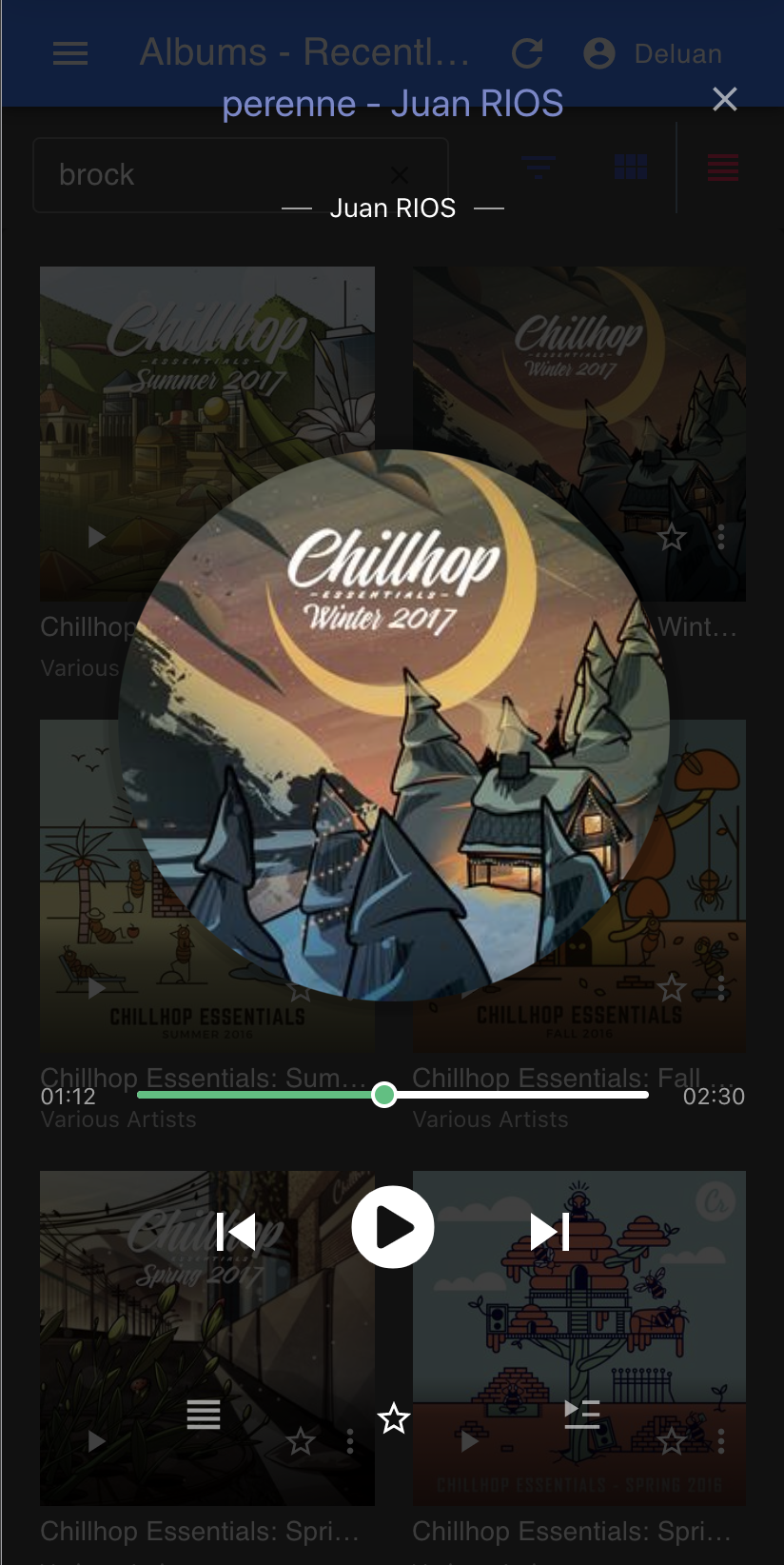
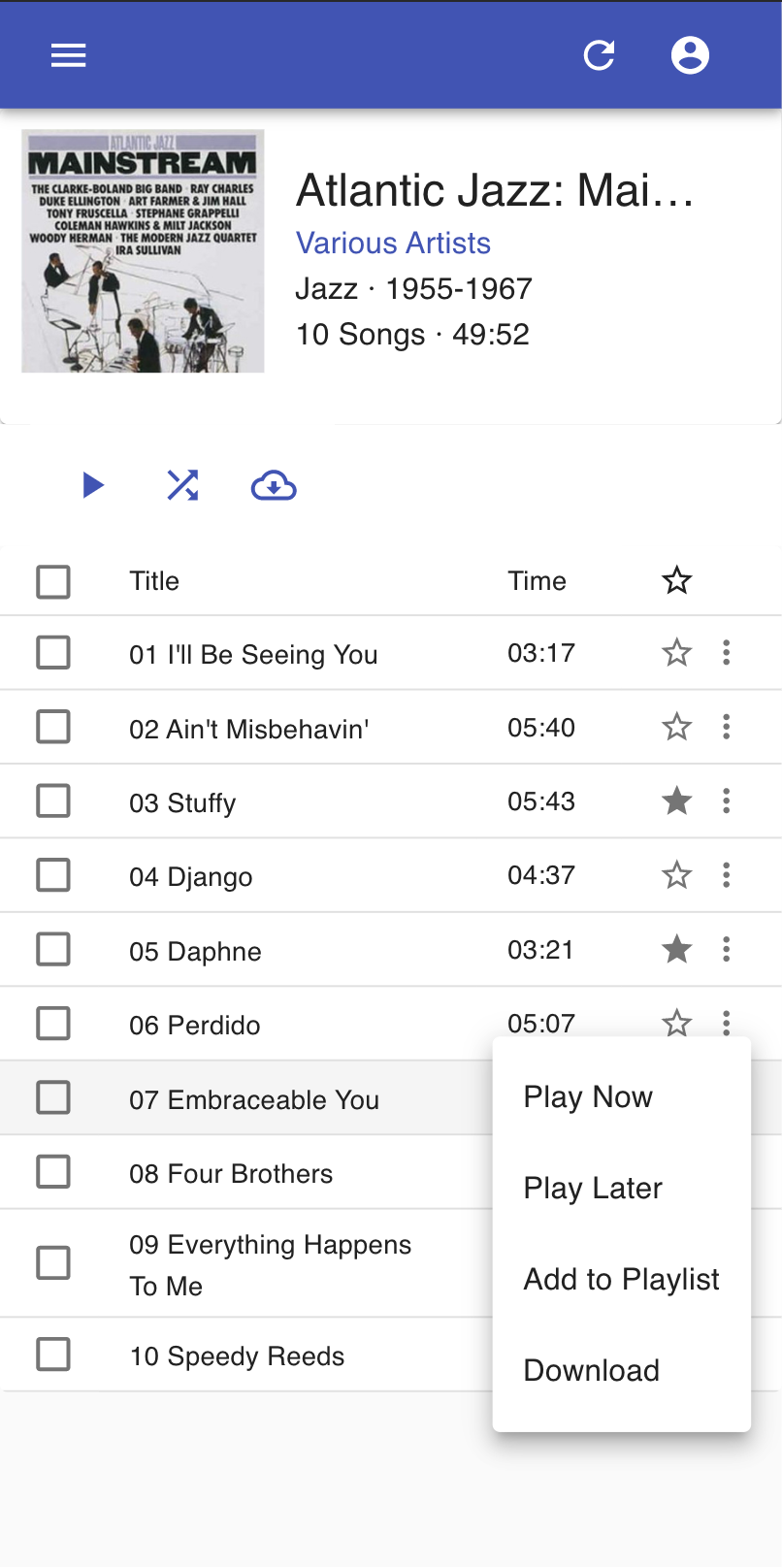
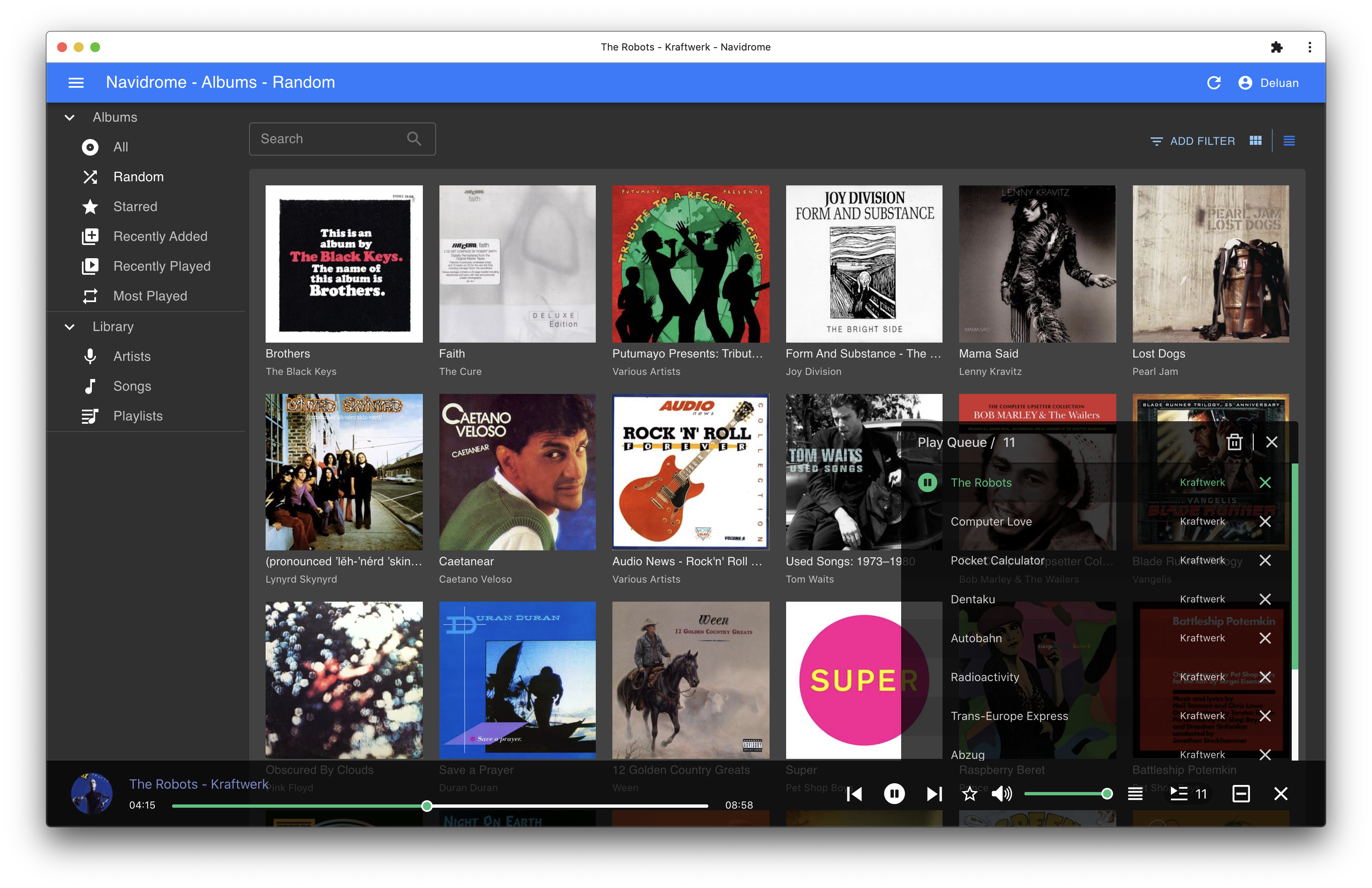
Screenshots